Memorandum on the recent observations in the serum-therapy of plague in India. Submitted to the sanitary commissioner with the Government of India, September 1907 / by Khan Bahadur N. H. Choksy.
- Choksy, Khan Bahadur N. H.
- Date:
- 1907
Licence: In copyright
Credit: Memorandum on the recent observations in the serum-therapy of plague in India. Submitted to the sanitary commissioner with the Government of India, September 1907 / by Khan Bahadur N. H. Choksy. Source: Wellcome Collection.
Provider: This material has been provided by London School of Hygiene & Tropical Medicine Library & Archives Service. The original may be consulted at London School of Hygiene & Tropical Medicine Library & Archives Service.
20/30 page 18
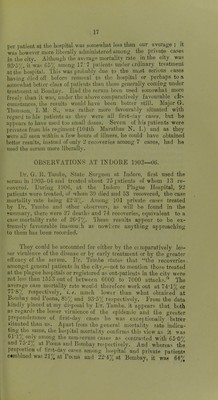
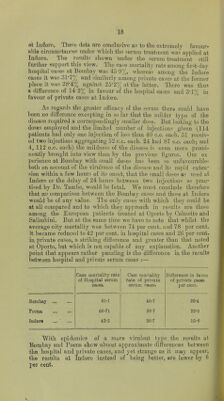
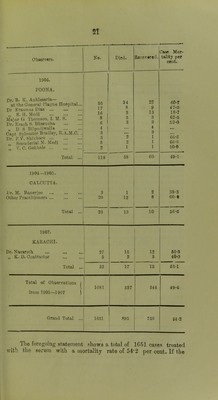
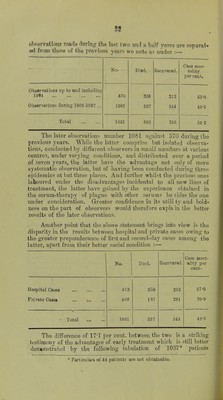
![at Indore, Thei?e data are conclusive as to the extremely favour- able circumstances under wliich the serum treatment was ap])lied at Indore. The results shown under the serum treatment still further support this view. The case mortality rate amontr first-day hospital eases at Bombay was 45'9%, whereas amon^r the Indore cases it was 31’7% and similarly amonc/ private cases at the former place it was 28'4% against 25*2% at the latter. There was thus a difference of 14 2% in favour of the hospital cases and 3*1% in favour of private cases at Indore. As regards the greater ef6cacy of the serum there could have been no difference excepting in so far that the milder type of the disease required a correspondingly smaller dose. But looking to the doses employed and the limited number of injections given (114 patients had only one injection of less than 40 c.c. each. 51 receiv- ed two injections aggregating 52 c.c. each. 24 had 87 e.c. each; and 4, 112 c.G. each) the mildne.ss of the disease is oven more promi- nently brought into view than by the previous figures. Our ex perience at Bombay with small doses has been so unfavourable> both on account of the virulence of the disease and its rapid exten sion within a few hours of its onset, that the small doses as used at Indore or the delay of 24 hours between two injections as prac- tised by Dr. Tambe, would be fatal. We must conclude therefore that no comparison between the Bombay cases and those at Indore would be of any value. The only cases with which they could be at all compared and to which they approach in results are those among the European patients treated at Oporto by Calmette and Salimbini. But at the same time we have to note that whilst the average city mortality was between 74 per cent, and 78 per cent, it became reduced to 42 per cent, in hospital cases and 26 per cent, in private cases, a strildng difference and greater than that noted at Oporto, but which is not capable of any explanation. Another point that appears rather puzzling is the difference in the results between hospital and private serum cases :— Case tDortality rate of Hospital serum cases. Case mortality rate of private serum cases. Difference in favou of private cases per cent. Botabay ... • • • 6M 40-7 20-4 Boona GO-71 38‘7 22‘0 Indor# ... ... 42-3 26-7 16-6 With epidemics of a nioi’e virulent type the results at Bombay and Poona show almost approximate differences between the hospital and private cases, and yet strange as it may appear, the results at Indore instead of being better, are lower by 6 per cent.](https://iiif.wellcomecollection.org/image/b24916547_0022.jp2/full/800%2C/0/default.jpg)
 No text description is available for this image
 No text description is available for this image
 No text description is available for this image