Memorandum on the recent observations in the serum-therapy of plague in India. Submitted to the sanitary commissioner with the Government of India, September 1907 / by Khan Bahadur N. H. Choksy.
- Choksy, Khan Bahadur N. H.
- Date:
- 1907
Licence: In copyright
Credit: Memorandum on the recent observations in the serum-therapy of plague in India. Submitted to the sanitary commissioner with the Government of India, September 1907 / by Khan Bahadur N. H. Choksy. Source: Wellcome Collection.
Provider: This material has been provided by London School of Hygiene & Tropical Medicine Library & Archives Service. The original may be consulted at London School of Hygiene & Tropical Medicine Library & Archives Service.
5/30 page 3
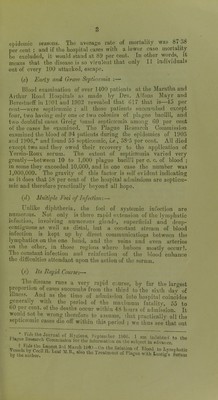
![epidemic seasons. The average rate of mortality was 87’.38 per cent ; and if the hospital cases with a lower case mortality bo excluded, it would stand at 89 per cent. In other words, it means that the disease is so virulent that only 11 individuals out of every 100 attacked, escape. (c) Early and Grave Septicaemia :— Blood examination of over 1400 patients at the Maratha and Arthur Road Hospitals as made by Drs. Alfons Mayr and Berestneff in IPOl and 1902 revealed that G17 that is—45 per cent—were sopticoeinic ; all those patients succumbed except four, two having only one or two colonies of plague liacilli, and two doubtful cases. Groig lound soptictemia among 60 per cent of the cases he examined. The Plague Research Commission examined the blood of 94 ])atients during the epidemics of 1905 aT!(l 1906,* and found 55 septicmmic, i.e., 58’5 por cent. All died except two and they owed their recovery to the application of Yersin-Roux serum. The extent of septictemia varied very greatly—between 10 to 1,000 plague bacilli per c. c. of blood ; in somo they exceeded 10,000, and in one case the number was 1,000,000. The gravity of this factor is self ev ident indicating as it does that 58 per cent of tho hospital admissions are septiem- mic and therefore practically beyond all hope. {d) Multiple Foci of Infection:— Unlike diphtheria, the foci of systemic infection aro numerous. Not only' is there rafiid extension of the ly'inphatic infection, involving numerous gland-=, superficial and deep- contiguous as well as distal, but a constant stream of blood infection is kept up by direct communicatiogs between tho lymphatics on tho ono hand, and tlio veins and even arteries on the other, in tho.se rogioirs where buboes mostly occurf. The constant infection and reinlection of tho blood enhance tho difficulties attendant upon tho action of the serum. (c) Its Rapid Course:—■ lhodisoa.se runs a very rapid course, by far the largest proportion of cases succumbs from the third to tho sixth dav of 1 ness. And as the time of admission into hospital coincides generally witli the period of the maximum fatality, 55 to 60 per cent, of the deaths occur within 48 hours of admission. It woiild not be wrong therefore to assume, ihat practically all the septicoemic cases die off within this period ; we thus see that out the Pi» * the J^rnal of Hygiene, September 190G. I am indebted lo I lague Research Commission lor the information on the subject in sdvaucc '](https://iiif.wellcomecollection.org/image/b24916547_0007.jp2/full/800%2C/0/default.jpg)