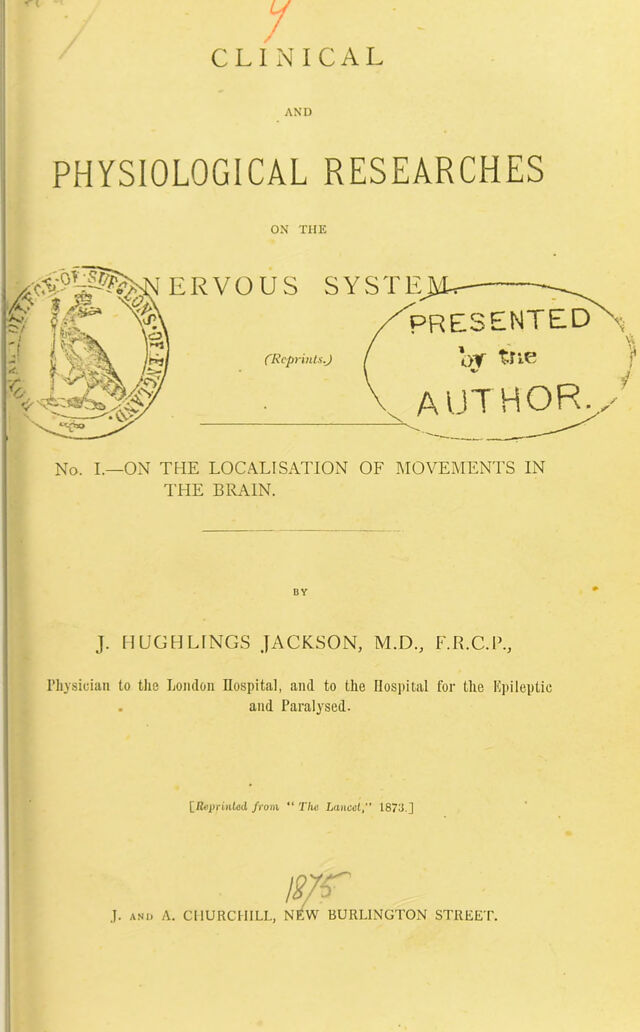
On the localisation of movements in the brain / by J. Hughlings Jackson.
- Jackson, John Hughlings, 1834-1911.
- Date:
- [1875]
Licence: Public Domain Mark
Credit: On the localisation of movements in the brain / by J. Hughlings Jackson. Source: Wellcome Collection.
Provider: This material has been provided by The Royal College of Surgeons of England. The original may be consulted at The Royal College of Surgeons of England.
14/90
![relation betwixt the neural process and' the feeling. It is_, I think, indeed convenient to make the distinction, even if it be purely artificial. The reader will observe that I did not in the paper here re- printed try to prove that the convolutions contain processes representing movement. I had for years assumed that convolu- tions contain processes representing movements and impressions. In fact, I cannot conceive of what other materials the cerebral hemisphere can be composed than of nervous arrangements representing impressions and movements. I have long taken this for granted when considering what is commonly called the Physiology of Mind, especially with regard to speech, as well as when speaking of convulsions and chorea. In a paper (Royal London Ophth. Hosp. Reports, Vol. v., part 4), published as far back as 1866, it is assumed through- out.* As I am anxious to show, for several reasons, that this notion had long ago become in my mind almost auto- matic, I will re-quote a footnote from a paper written five years ago. It had become so automatic, that although it is implied throughout that paper that the convolutions contain processes representing movements, my belief to that effect is only explicitly stated in the part here reproduced. I mention this to account for the statement appearing in a foot note. In fact, in every paper written during and since 1866, whether on chorea, convulsions, or on the physiology of language, I have always written on the assumption that the cerebral # One quotation from that paper will show this. “ So far as we can know anything definite of mind [the actions of the anatomical substrata of mind, I should have said], it is made up of sensory and motor phenomena—the functions of a series of anatomical possibilities in the cerebrum in correspondence with its wide environment,” etc. Again, page 290—“ On the evolution of movements I have spoken several times, especially as regards the arm-nervous-system—i.e, from nerve-trunks supplying muscles directly to the corpus striatum.” As the observation of Hilton on the method of nerve supply to skin, muscles and joints, shows, there is in the ulti mates of the body rudimentary or incipient co-ordina- tion. The following is a further quotation referring to the sentence last quoted: —“ If such an expression be permitted, there is a gradual increase in intelligence in movements from the lowest nerve trunks to the highest centres.](https://iiif.wellcomecollection.org/image/b22355078_0016.jp2/full/800%2C/0/default.jpg)