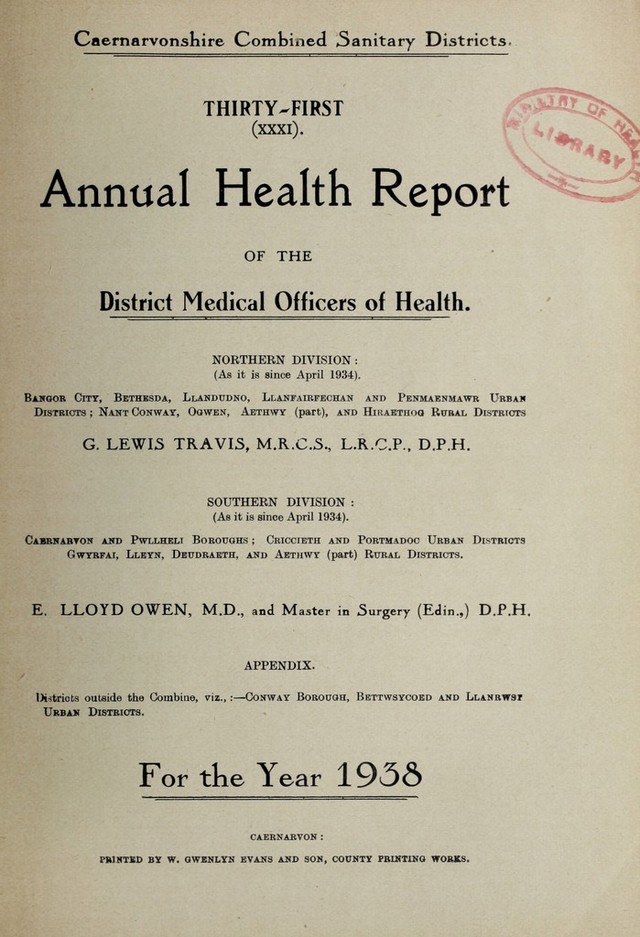
[Report 1938] / Medical Officer of Health, Caernarvonshire Combined Sanitary Districts (Bangor City, Conway Borough, Bethesda U.D.C., Betws y Coed U.D.C., Llandudno U.D.C., Llanfairfechan U.D.C., Penmaenmawr U.D.C., Nant Conway R.D.C., Ogwen R.D.C., Caernarvon Borough, Pwllheli Borough, Criccieth U.D.C., Portmadoc U.D.C., Gwyrfai R.D.C., Lleyn R.D.C.).
- Caernarvonshire Combined Sanitary Districts.
- Date:
- 1938
Licence: Attribution 4.0 International (CC BY 4.0)
Credit: [Report 1938] / Medical Officer of Health, Caernarvonshire Combined Sanitary Districts (Bangor City, Conway Borough, Bethesda U.D.C., Betws y Coed U.D.C., Llandudno U.D.C., Llanfairfechan U.D.C., Penmaenmawr U.D.C., Nant Conway R.D.C., Ogwen R.D.C., Caernarvon Borough, Pwllheli Borough, Criccieth U.D.C., Portmadoc U.D.C., Gwyrfai R.D.C., Lleyn R.D.C.). Source: Wellcome Collection.
10/154
![Givyrfai Rural District. “ Dr. Chalke records that, as long ago as 1913, a letter was received by the Council from the Local Government Board stating that the Board intended issuing an Order requiring the Council to erect dwelling houses (to be completed within 9 months from the date of the Order), in the neighbourhood of Ebenezer and Clwtybont. “ This was never carried into effect (was the Order issued, or was it held over be- cause of the Great War ? E. LI. Owen)., and between this date and June, 1933, when Dr. Chalke’s Report was issued, only 6 houses (at Clwtybont) had been erected by the Local Authority. (504 Council Houses owned in June, 1939. E. LI. Owen). “As a result of Dr. Chalke’s Report, a conference was called at Caernarvon of the representatives of all Local Authorities and Insurance Committees. Arising out of this Conference, a number of Recommendations were made and approved. “ These recommendations, together with the observations of the County Council thereon, were considered at a meeting of the Health Committee of the County Council on the 21st July, 1934, and following upon that meeting, a communication was sent by the County Council to the Gwyrfai R. D. Council. But in our opinion much more vigorous action should have been taken immediately (by the County Council or the Gwyrfai Council, or both ? E. LI. Owen). “ Undoubtedly, since 1936, the Gwyrfai Council has been deeply concerned about Housing, Sewerage, and Water, and there is an awakening throughout the District as to the needs of the people. “ The Council has erected a large number of new houses, and a large number are in course of erection, while tenders have been invited for many more. The Council are also negotiating for Housing Sites in many of the villages, and we believe they are determined, as soon as they reasonably can, to rectify the conditions which they themselves described to us as appalling. We believe also that the County Council will exercise a vigilant super- vision over the Rural District Council, [without neglecting their own district.—E. LI. Owen], “ In his reports on Gwyrfai, Dr. Lloyd Owen has called attention to the shortage of houses, with resultant Overcrowding, and he also states that there are a great number of dwellings which might have been, but for the shortage, condemned as unfit. He has also reminded the Gwyrfai R. D. Council of their failure in the past to take advantage of the Housing Acts and Exchequer Subsidies (page 154). “ Since January, 1935, in the Gwyrfai District, the cost of both Water and Sewerage Schemes is borne on the General Rate instead of by the individual Parishes, and, as a result, useful and necessary schemes have been carried out. It is the policy of the Gwyrfai Council to prepare Schemes for the benefit of smaller outlying hamlets in their District. “ Between January, 1935, and March, 1938, 10 Sewage-disposal Works were con- structed in the villages, and 15 new Sewers and Extensions of Sewers have been laid, while other Schemes are in course of being undertaken. Further, quite a number of Water Schemes have been completed. (504 Council Houses owned in July, 1939. E. LI. Owen). Lleyn Rural District. “ Dr. Lloyd Owen, in his Report for 1935, called attention to the acute shortage of healthy houses, of the working-class type to meet the needs of new' tenants, and to re- place insanitary dwellings. “ He states that not a single Council House had been built, nor had any applications been made under the Housing (Rural Workers) Act, 1931. “ ‘ In spite of hard pleading on my part, the Council declined to make a claim 4 until it was too late for the Supplementary Grants under the Housing (Rural Autho- rities), Act, 1931. These grants would have been in addition to the ordinary grant ‘ available under the Wheatley Act, 1924), and would have enabled the houses to be ‘ Jet for about 2s. 6d. a week, including the rates.](https://iiif.wellcomecollection.org/image/b29690900_0010.jp2/full/800%2C/0/default.jpg)