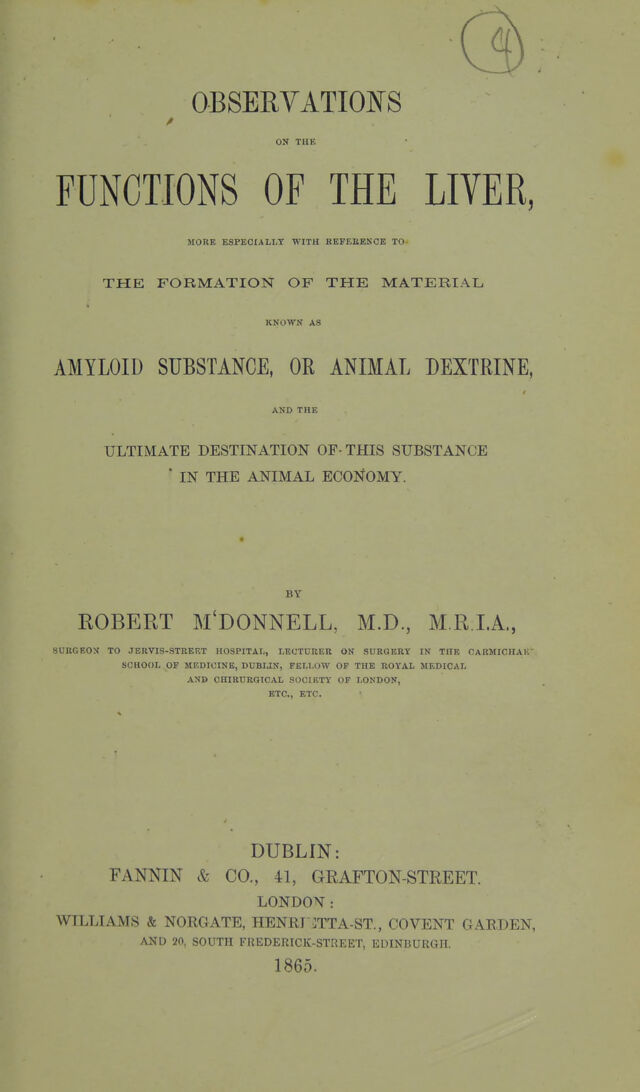
Observations on the functions of the liver : more especially with reference to the formation of the material known as amyloid substance, or animal dextrine, and the ultimate destination of this substance in the animal economy / by Robert M'Donnell, M.D.
- Robert McDonnell
- Date:
- 1865
Licence: Public Domain Mark
Credit: Observations on the functions of the liver : more especially with reference to the formation of the material known as amyloid substance, or animal dextrine, and the ultimate destination of this substance in the animal economy / by Robert M'Donnell, M.D. Source: Wellcome Collection.
Provider: This material has been provided by The University of Glasgow Library. The original may be consulted at The University of Glasgow Library.
42/54 page 32
![of tissue, resulting in an increase of the fibrine, is checked from want of nitrogenous food; hence, the fibrine-destroying func- tion of the liver is also checked. As a result, less bile is secreted, and less nitrogen supplied for the azotisation of the amyloid substance, which, in consequence of not being used in the normal way, accumulates in the tissue of the Hver. The fact that the urea excreted is remarkably dmiinished by an exclusively amylaceous diet, and that the urine of the carnivora* is so much richer in this material than that of the herbivora, points obviously in the same direction as the foregoing, t Convparison between the Blood wJiich enters and that which leaves the Liver. It is a tolerably easy matter to obtain enough of portal blood for chemical examination. If the portal vem is expe- ditiously lied, in order to prevent regurgitation from the liver, and the vein, or some of its larger tributaries, opened below ■•' The quantity of uvea in cats urine, as compared with rabbits, is enormously large. The siiecific gravity of the former I have found as high as 1070, while it gave 7.740 grains of urea in each fluid dram, or nearly 62 grains to the tiuid ounce. , , . . •,- ■ ^ n t A very interesting memoir relating to the cholestenne elimmated by the liver has ap])eared in the American Journal of Medical Science, from the pen of Dr. Austin Flint, jun., Professor of Physiology to the Bellevue Hospital Medical College. It is entitled, Experimental Researches on a New Excretory Function of the Liver, consisting in the Separation of Cholesterine from the Blood, and its Expulsion from the Economy under the form of Stercorine (Seroline of Boudet). , . , ^ ■^,•4.1 The following are the more important results at which Dr. Fli at has ' 1st. Cholesterine exists in the bile, the blood, nervous tissue meco- nium • but normally, does not exist in the fjeces. The quantity of chlolesterine furnished by the venons blood of the arm, is from hve to eight times greater than has been generally supposed. _ 2nd. Cholesterine is formed in great part if not entirely, the ner- vous tissue in which it exists in great abundance. It is separated from Tt by the biood, and constitutes one of the most important excrementuil products of the economy. Its formation is continuous, and its existence in the blood and nervous tissue is constant. ,, , , ^, ,. -i. • S Cholesterine is separated from the blood by the liver. It is an elemtt cot a^^tpresent in bile, and is poured forth into the digestjve tube. It is separated by the liver, not produced by it; and, if th^s senaration is disturbed, it accumulates m the systeni. . . S Stercorine is the form under which cholesterine is ejected from the body Ordinary normal faeces contain no cholesterine ; but they contaS stercorhie (formerly known as seroline), which is a product XSg from StiUsformation of the cholesterine of the bile dunug the digestive process.](https://iiif.wellcomecollection.org/image/b21482482_0042.jp2/full/800%2C/0/default.jpg)