Outline of an inquiry on the pathology of consumptive diseases. Part I / by John Abercrombie.
- Date:
- [1821]
Licence: Public Domain Mark
Credit: Outline of an inquiry on the pathology of consumptive diseases. Part I / by John Abercrombie. Source: Wellcome Collection.
Provider: This material has been provided by the Royal College of Physicians of Edinburgh. The original may be consulted at the Royal College of Physicians of Edinburgh.
5/38
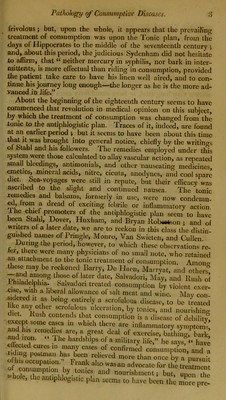
![frivolous; but, upon the whole, it appears that the prevailing treatment of consumption was upon the Tonic plan, from the days of Hippocrates to the middle of the seventeenth century ; and, about this period, the judicious Sydenham did not hesitate to affirm, that “ neither mercury in syphilis, nor bark in inter- mittents, is more effectual than riding in consumption, provided the patient take care to have his linen well aired, and to con- tinue his journey long enough—the longer as he is the more ad- vanced in life.” About the beginning of the eighteenth century seems to have commenced that revolution in medical opinion on this subject, by which the treatment of consumption was changed from the tonic to the antiphlogistic plan. Traces of it, indeed, are found at an earlier period ; but it seems to have been about this time that it was brought into general notice, chiefly by the writings of Stab] and his followers. The remedies employed under this system were those calculated to allay vascular action, as repeated small bleedings, antimonials, and other nauseating medicines, emetics, mineral acids, nitre, cicuta, anodynes, and cool spare diet, bea-voyages were still in repute, but their efficacy was ascribed to the slight and continued nausea. The tonic remedies and balsams, formerly in use, were now condemn- fro™ a dread of exciting febrile or inflammatory action, Ihe chief promoters ot the antiphlogistic plan seem to have been Stahl, Dover, Huxham, and Bryan Robertson ; and of writers of a later date, we are to reckon in this class the distin- guished names of Pringle, Monro, Van Swieten, and Cullen. During the period, however, to which these observations re- fer, there were many physicians of no small note, who retained an attachment to the tonic treatment of consumption. Amono- these may be reckoned Barry, Do Haen, Marryat, and others* KiMdnv”8 ‘sT °,f l“-t0r date,’ Sal,adori> M»y. »nd Rush of JrhiJadelphia. fea.vadon treated consumption by violent exer- cise, with a liberal allowance of salt meat and wine. May con- sidered it as being entirely a scrofulous disease, to be treated ietaYl{er scrofulous ulceration, by tonics, and nourishing diet. Kush contends that consumption is a disease of debility, cxcep some cases in which there are inflammatory symptom** and his remedies are, a great deal of exercise, bathing, bark 2d,:T‘ lhe hardshiPs <>£■« military life,” he saysf“ have • i; cures in many cases of confirmed consumption, and a iding postman has been relieved more than once by a pursuit of luS occupation. Frank also was an advocate for the treaS ln]f ?mptr,iby.t0nics and nourishment; but, upon She c, the antiphlogistic plan seems to have been the more pre-](https://iiif.wellcomecollection.org/image/b21958373_0007.jp2/full/800%2C/0/default.jpg)