Antiquities of the St. Francis, White, and Black Rivers, Arkansas / by Clarence B. Moore.
- Clarence Bloomfield Moore
- Date:
- 1910
Licence: Public Domain Mark
Credit: Antiquities of the St. Francis, White, and Black Rivers, Arkansas / by Clarence B. Moore. Source: Wellcome Collection.
36/162 page 280
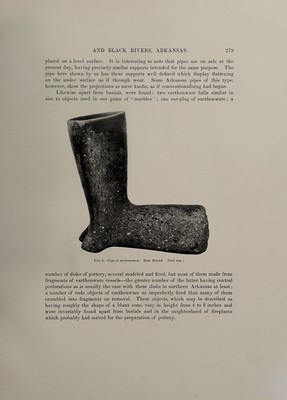
![Cones of this type1 vary somewhat in minor particulars, some having, and some being without, holes in the apices, and will be referred to in connection with other mounds along the river. These fireplaces were not characterized by the ordinary debris found near fires devoted to culinary purposes, but contained masses of burnt clay, of irregular shape, ranging in size to double that of a closed hand. Possibly these masses had served in the construction of ovens for firing pottery, as with these masses were found numbers of fragments of vessels, which had a new appearance and did not seem to have been in use, but rather appeared to be parts of vessels that had broken in the process of firing. Side by side were three objects, similar to one another, of half-fired clay, fiat as to the base, with convex upper surface and rounded ends, much resembling cer¬ tain loaves of bread in shape. Longitudinally, on each upper surface, is a groove .75 inch in width. Also apart from burials were four tubular beads of copper; one perforated cyl¬ inder of charred wood; piercing implements of bone; eight arrowpoints of flint, seven leaf-shaped, one barbed; rude discoidal stones, some made from pebbles; flint knives; chisels wrought from pebbles of flint; pitted stones; seven “celts,’’ five of quartzite, one of igneous rock, and one of flint, ranging from 2.1 inches to 4.5 inches in length. We shall now turn to artifacts which were associated with burials. Of the two hundred and seven burials in the Rose Mound there were twenty- two which had with each of them, usually, but not always, associated with a vessel or vessels of earthenware, a single bead of shell, two beads of shell, or a number of shell beads, nearly all of which were badly decayed. Of these twenty-two burials, four were of adults and eighteen were of children, including infants. We shall now describe in detail all burials found by us at the Rose Mound that were accompanied with artifacts other than shell beads or vessels of earthen¬ ware, but we shall include in our description beads of shell and pottery utensils when they were found yvith these burials in connection with other objects. Burial No. 3, adult, partly flexed on the left side, had eighteen curious objects of earthenware, pillar-shaped, flat on what presumably are the bases, and slightly 1 It is interesting to note that similar cones were in use under like conditions in prehistoric Europe. In an article on the excavation of stone-age dwelling-pits and cremation-graves in the Hanau region, Prof. Friedrich Heiderich writes—“The second dwelling-pit was likewise round, and of about the same dimensions as the first. A definite fireplace was not recognizable within it [as there was in the first]. There were found a quantity of sherds of large vessels, quite like those of the former pit, but lying scattered throughout. In the center of the pit a well preserved mealing-stone lay overturned. .Further there was found in the vicinity of the mealing stone, a peculiar object of burnt clay, of sugar-loaf form—the use of which is problematical. Its height is 16 cm.; the diameter at the base, 10 cm. This object is not perforated at the point, as are similar ones which have been found in other localities. [Translation]—Korrespondenz-Blatt der Beutschen Gesellschaft fur Anthropologie, Ethnologie und Urgeschichte, XLI-1-3, p. 11, Archiv fur Anthropologie, N. F., B. IX. With the text is an illustration showing a cone of earthenware greatly resembling some found by us on St. Francis river.](https://iiif.wellcomecollection.org/image/b31364901_0036.jp2/full/800%2C/0/default.jpg)