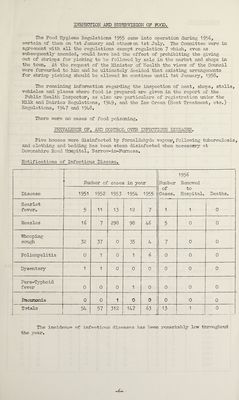
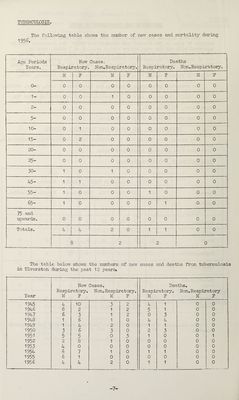
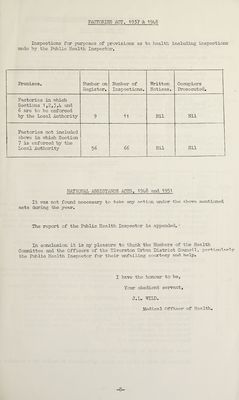
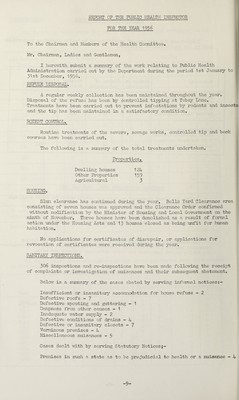
[Report 1956] / Medical Officer of Health, Ulverston U.D.C.
- Ulverston (England). Urban District Council.
- Date:
- 1956
Licence: Attribution 4.0 International (CC BY 4.0)
Credit: [Report 1956] / Medical Officer of Health, Ulverston U.D.C. Source: Wellcome Collection.
12/14 page 11
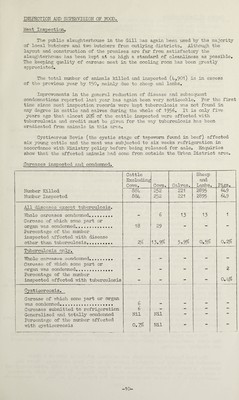
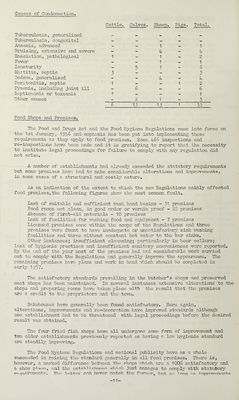
![Causes of Condemnation, Cattle. Calves. Sheep. Pigs. Total.. Tuberculosis, generalised Tuberculosis, congenital — — — — — Anaemia, advanced — — 1 — 1 Bruising, extensive and severe — — 4 — 4 Emaciation, pathological 1 — 1 — 2 Fever — — -j — 1 Immaturity — 5 1 — r O Mastitis, septic 3 — — — 3 Oedema, generalised — — 4 — 4 Peritonitis, septic 1 — — 1 2 pyaemia, including joint ill — 6 — — 6 Septicaemia or toxaemia 1 — — 1 Other causes — 2 1 — 3 “IT 13 13 ■] 33 Pood Shops and Premises. The Pood and Drugs Act and the Pood Hygiene Regulations came into force on the 1st January, 1956 and emphasis has been put into Implementing these requirements as they apply to food premises. Some 4.66 inspections and ne-inspections have been made and it is gratifying to report that the necessity to institute legal proceedings for failure to comply with any regulation did not arise. A number of establishments had already exceeded the statutory requirements but some premises have had to make considerable alterations and improvements, in some cases of a structural and costly nature. As an indication of the extent to which the new Regulations mainly affected food premises,the following figures show the most common fault. Lack of suitable and sufficient wash hand basins - 31 premises Pood rooms not clean, in good order or vermin proof - 22 premises Absence of first-aid materials - 10 premises Lack of facilities for washing food and equipment - 7 premises Licensed premises came within the scope of the Regulations and three premises were fount to have inadequate or unsatisfactory sink washing facilities and three without constant hot water to the bar sinks. Other instances; insufficient cleansing; particularly in beer cellars; lack of hygienic practices and insufficient sanitary conveniences were reported. By the end of the year most of the premises had had considerable work carried out to comply with the Regulations and generally improve the appearance. The remaining premises have plans and work in hand which should be completed in early 1957. The satisfactory standards prevailing in the butcher’s shops and preserved meat shops has been maintained. In several instances extensive alterations to the shops and preparing rooms have taken place with the result that the premises are a credit to the proprietors and the town. Bakehouses have generally been found satisfactory. Here again, alterations, improvements and rc-decoration have improved standards although one establishment had to be threatened with legal proceedings before the desired result was obtained. The four fried fish shops have all undergone some form of improvement and two older establishments previously reported as having a. low hygienic standard are steadily improving. The Pood Hygiene Regulations and national publicity have as a whole succeeded in raising the standard generally in all food premises. There is, however, a marked difference between the chops which are a 1OO/o satisfactory and a show pi oco, and the estahi -i^hment whi ch just manages to comply with statutory ■acquirements. The Tn.ttcz' can never match the former, hut. so long taw Improvernen+.s -11-](https://iiif.wellcomecollection.org/image/b30200957_0012.jp2/full/800%2C/0/default.jpg)