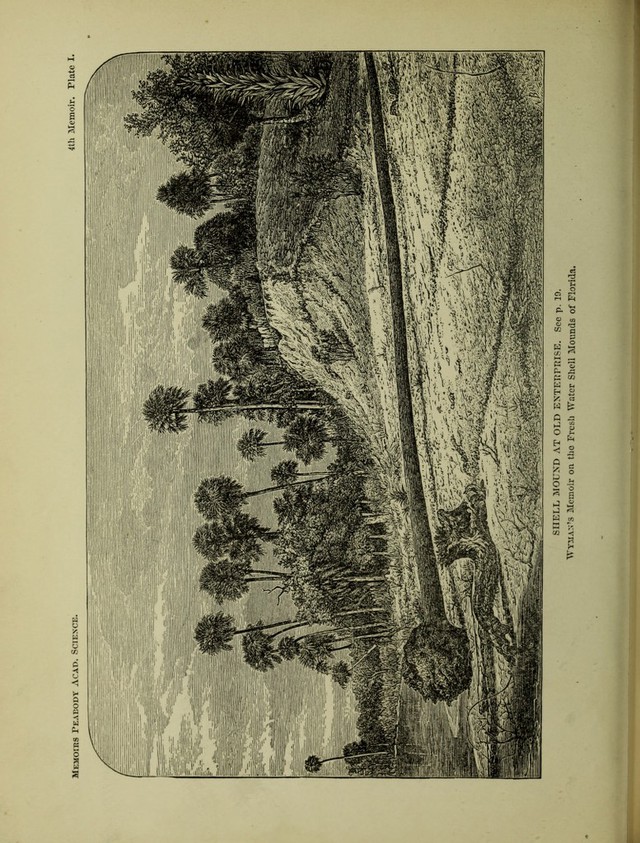
Fresh-water shell mounds of the St. John's River, Florida / by Jeffries Wyman.
- Jeffries Wyman
- Date:
- 1875
Licence: Public Domain Mark
Credit: Fresh-water shell mounds of the St. John's River, Florida / by Jeffries Wyman. Source: Wellcome Collection.
Provider: This material has been provided by The Royal College of Surgeons of England. The original may be consulted at The Royal College of Surgeons of England.
56/120 page 46
![Cuvier may be accepted, the places where he [man] dwelt may have been utterly destroyed and his*bones buried at the bottom of the existing seas.”52 It is almost certain that his bones, if simply left on the surface, would, like those of land animals generally, be soon entirely destroyed, either by the effects of the weather or their consumption for food by wild animals. Nothing can be more striking than the complete destruction of the bones of the birds and reptiles, some of gigantic size, which once thronged the shores in the valley of the Connecticut River. Were it not for the preser- vation of their seemingly more perishable footprints, the mere knowledge that they once lived would not now exist. The same is doubtless true of other kinds whose habitat was inland, and whole races of mammals and birds may have once existed of which no traces whatever remain, and this too within comparatively recent times. Keeping these considerations in view, it seems not at all improbable that the same fate may have befallen the remains of the earliest man. As the ease with which food can be procured determines the habitat of ani- mals, so also it determines that of man, and this naturally brings him to the shores of seas, lakes and rivers where it can be had with the greatest ease. It is hardly conceivable that he could, under any circumstances, at once have entered upon an agricultural or hunter life, since these both require ex- pedients and inventions which long experience and education alone can give. Without tools or inventions of any sort, life in the forest, it would seem, would be for him almost impossible. Be this as it may, the wide geographical distribution of shell heaps shows how generally man has been attracted by the kind of food the shores yield, including not only shell- fish, but fish and game, and the extent to which they have supplied his wants in his early periods. They are found at intervals along the whole Atlan- tic coast of the United States from the Bay of Fundy to the Gulf of Mexico, on the shores of California and northward to Behring's Sea, in Central America, the Gulf of Guayaquil, on the coast of Brazil, Pata- gonia and Terra del Fuego, on the shores of England, Scotland, Ireland, France and Denmark, in the Malay Peninsula, in Australia and Tasmania, and will doubtless be discovered in still other parts of the world. Besides those just mentioned other shell heaps have been found on the interior rivers of this continent, especially the Mississippi and its tribu- taries. Atwater, who was the pioneer in inquiries relating to them, de- scribed the mounds of mussel shells on the banks of the Muskingum53 containing various articles of human make, and Le Sueur and Say ex- plored a mound at New Harmony, Indiana, as early as 1826.54 Since then Dr. D. G. Brinton55, Dr. Cox, Generals Humphreys and Abbot,56 and Prof. 62 Discours sur les Revolutions de la surface du Globe, Oss. Foss., 4me edition, Paris, 1834, T. I, p. 217. 63 Archaeologia Americana, Vol. I, p. 226. 44 Foster. Prehistoric Man. “Smithsonian Report. 1866. p. 356. “Report upon the Physics and Hydraulics of the Mississippi River, p. 89.](https://iiif.wellcomecollection.org/image/b22326881_0058.jp2/full/800%2C/0/default.jpg)