Annual report of the Board of Management : 1942.
- Royal National Hospital for Consumption and Diseases of the Chest
- Date:
- 1942
Licence: Public Domain Mark
Credit: Annual report of the Board of Management : 1942. Source: Wellcome Collection.
32/88 page 24
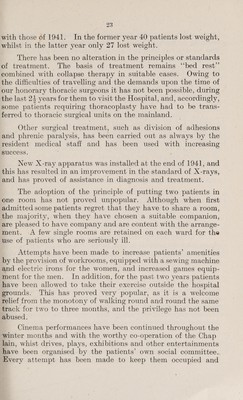
![happy. We have been exceedingly fortunate in the interest taken in us by local artistes and amateur dramatic societies, who have given us many excellent shows, for wdiich we are most grateful. Holiday Gamps. Two holiday camps in Bembridge were taken over by the Hospital on the 7th September 1939, and were opened for the treatment of ambulant cases of tuberculosis on the 21st September. The men’s camp had accommodation for 130 and the women’s for 50 patients, and consisted of camps built for summer use, comprising smal] huts (either single or double) arranged around a central house, which acted as dining rooms and to which was attached a large recreation hut. When taken over, there was only one bath room in each camp, and washing arrangements were urgently required. Additional bathrooms and basins were installed in the women’s camp, and in the men’s camp the garage was converted into a shower room. Only a minimum staff was engaged, consisting of a matron and assistant nurse for each camp, cooks and a few porters. Patients (who were all ambulant cases) were expected and were able to look after their own huts and to help with other work. All patients co-operated willingly. A library and games equipment wTas available at both camps, and the patients in each camp formed their own council for the organisation of their social life. A cinema show was given each week and competitions, games and entertainments were a feature of the camp life. It was unfortunate that we had to work under winter conditions in camps that were only built for summer use, and, starting as we did in the winter of 1939, the conditions at times were exceedingly hard. However, the patients survived it all. The majority were very happy and enjoyed the life and often protested vigorously wdien their discharge was suggested. The patients were selected for transfer to the camps from the Hospital, and only those who had early disease in a healing stage, or in whom the disease had been satisfactorily controlled by collapse therapy were transferred. The progress made by](https://iiif.wellcomecollection.org/image/b31707026_0032.jp2/full/800%2C/0/default.jpg)



 No text description is available for this image
 No text description is available for this image
 No text description is available for this image