Experiments in plant hybridisation / Mendel's original paper in English translation, with commentary and assessment by Sir Ronald A. Fisher, together with a reprint of W. Bateson's biographical notice of Mendel ; edited by J.H. Bennett.
- Mendel, Gregor, 1822-1884. Versuche über Pflanzenhybriden. English
- Date:
- [1965]
Licence: Attribution-NonCommercial-NoDerivatives 4.0 International (CC BY-NC-ND 4.0)
Credit: Experiments in plant hybridisation / Mendel's original paper in English translation, with commentary and assessment by Sir Ronald A. Fisher, together with a reprint of W. Bateson's biographical notice of Mendel ; edited by J.H. Bennett. Source: Wellcome Collection.
48/116 (page 34)
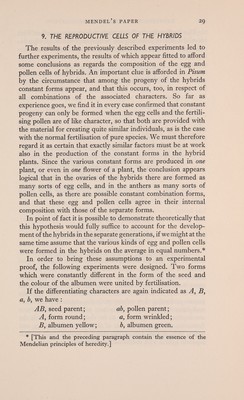
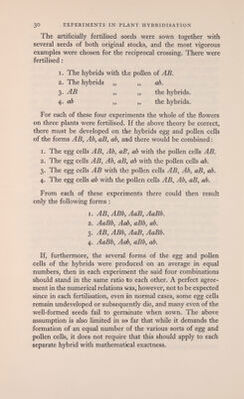
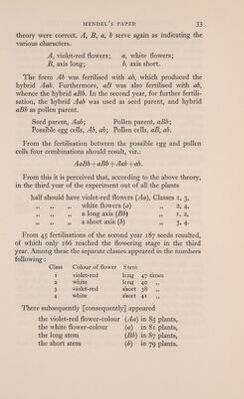
![34 EXPERIMENTS IN PLANT HYBRIDISATION The theory adduced is therefore satisfactorily confirmed in this experiment also. For the characters of form of pod, colour of pod, and position of flowers, experiments were also made on a small scale and results obtained in perfect agreement. All combinations, which were possible through the union of the differentiating characters duly appeared, and in nearly equal numbers. Experimentally, therefore, the theory is confirmed that the pea hybrids form egg and pollen cells which, in their con¬ stitution, represent in equal numbers all constant forms which result from the combination of the characters united in fertilisation. The difference of the forms among the progeny of the hybrids, as well as the respective ratios of the numbers in which they are observed, find a sufficient explanation in the principle above deduced. The simplest case is afforded by the developmental series of each pair of differentiating characters. This series is represented by the expression A-¡-2Aa-¡-a, in which A and a signify the forms with constant differentiating characters, and Aa the hybrid form of both. It includes in three different classes four individuals. In the formation of these, pollen and egg cells of the form A and a take part on the average equally in the fertilisation; hence each form [occurs] twice, since four individuals are formed. There participate consequently in the fertilisation the pollen cells A-j-A-j-a-j-a, the egg cells A-j-A-^-a-j-a. It remains, therefore, purely a matter of chance which of the two sorts of pollen will become united with each separate egg cell. According, however, to the law of probability, it will always happen, on the average of many cases, that each pollen form A and a will unite equally often with each egg cell form A and a, consequently one of the two pollen cells A in the fertili¬ sation will meet with the egg cell A and the other with an egg cell a, and so likewise one pollen cell a will unite with an egg cell A, and the other with egg cell a. Pollen cells A A a a I v ' I 'I' Egg cells A A a a](https://iiif.wellcomecollection.org/image/b18033131_0049.JP2/full/800%2C/0/default.jpg)