Experiments in plant hybridisation / Mendel's original paper in English translation, with commentary and assessment by Sir Ronald A. Fisher, together with a reprint of W. Bateson's biographical notice of Mendel ; edited by J.H. Bennett.
- Mendel, Gregor, 1822-1884. Versuche über Pflanzenhybriden. English
- Date:
- [1965]
Licence: Attribution-NonCommercial-NoDerivatives 4.0 International (CC BY-NC-ND 4.0)
Credit: Experiments in plant hybridisation / Mendel's original paper in English translation, with commentary and assessment by Sir Ronald A. Fisher, together with a reprint of W. Bateson's biographical notice of Mendel ; edited by J.H. Bennett. Source: Wellcome Collection.
52/116 (page 38)
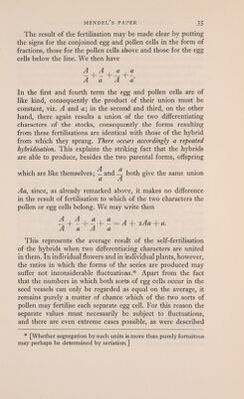
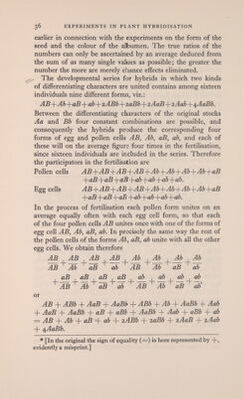
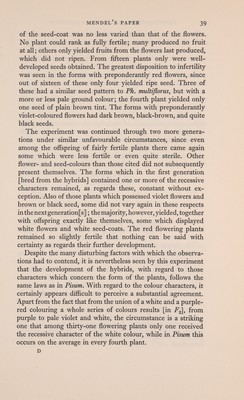
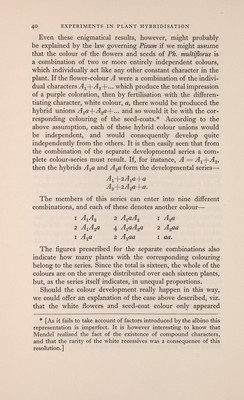
![38 EXPERIMENTS IN PLANT HYBRIDISATION The green colour of the pod, the inflated forms, and the long axis were, as in Pisum, dominant characters. Another experiment with two very different species of Phaseolus had only a partial result. Phaseolus nanus, L., served as seed parent, a perfectly constant species, with white flowers in short racemes and small white seeds in straight, inflated, smooth pods; as pollen parent was used Ph. multiflorus, W., with tall winding stem, purple-red flowers in very long racemes, rough, sickle-shaped crooked pods, and large seeds which bore black flecks and splashes on a peach-blood-red ground. The hybrids had the greatest similarity to the pollen parent, but the flowers appeared less intensely coloured. Their fertility was very limited; from seventeen plants, which together developed many hundreds of flowers, only forty-nine seeds in all were obtained. These were of medium size, and were flecked and splashed similarly to those of Ph. multifiorus, while the ground colour was not materially different. The next year forty-four plants were raised from these seeds, of which only thirty-one reached the flowering stage. The characters of Ph. nanus, which had been altogether latent in the hybrids, reappeared in various combinations; their ratio, however, with relation to the dominant plants was necessarily very fluctuating owing to the small number of trial plants. With certain characters, as in those of the axis and the form of pod, it was, however, as in the case of Pisum, almost exactly 1:3. Insignificant as the results of this experiment may be as regards the determination of the relative numbers in which the various forms appeared, it presents, on the other hand, the phenomenon of a remarkable change of colour in the flowers and seed of the hybrids. In Pisum it is known that the characters of the flower- and seed-colour present themselves unchanged in the first and further generations, and that the offspring of the hybrids display exclusively the one or the other of the characters of the original stocks. It is otherwise in the experiment we are considering. The white flowers and the seed- colour of Ph. nanus appeared, it is true, at once in the first generation [from the hybrids] in one fairly fertile example, but the remaining thirty plants developed flower-colours which were of various grades of purple-red to pale violet. The colouring](https://iiif.wellcomecollection.org/image/b18033131_0053.JP2/full/800%2C/0/default.jpg)