Experiments in plant hybridisation / Mendel's original paper in English translation, with commentary and assessment by Sir Ronald A. Fisher, together with a reprint of W. Bateson's biographical notice of Mendel ; edited by J.H. Bennett.
- Mendel, Gregor, 1822-1884. Versuche über Pflanzenhybriden. English
- Date:
- [1965]
Licence: Attribution-NonCommercial-NoDerivatives 4.0 International (CC BY-NC-ND 4.0)
Credit: Experiments in plant hybridisation / Mendel's original paper in English translation, with commentary and assessment by Sir Ronald A. Fisher, together with a reprint of W. Bateson's biographical notice of Mendel ; edited by J.H. Bennett. Source: Wellcome Collection.
59/116 (page 45)
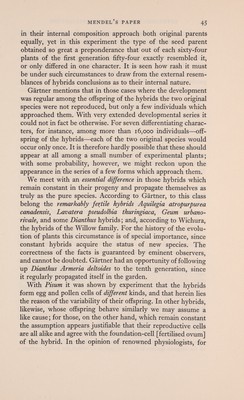
![Mendel's paper 45 in their internal composition approach both original parents equally, yet in this experiment the type of the seed parent obtained so great a preponderance that out of each sixty-four plants of the first generation fifty-four exactly resembled it, or only differed in one character. It is seen how rash it must be under such circumstances to draw from the external resem¬ blances of hybrids conclusions as to their internal nature. Gärtner mentions that in those cases where the development was regular among the offspring of the hybrids the two original species were not reproduced, but only a few individuals which approached them. With very extended developmental series it could not in fact be otherwise. For seven differentiating charac¬ ters, for instance, among more than 16,000 individuals—off¬ spring of the hybrids—each of the two original species would occur only once. It is therefore hardly possible that these should appear at all among a small number of experimental plants; with some probability, however, we might reckon upon the appearance in the series of a few forms which approach them. We meet with an essential dijference in those hybrids which remain constant in their progeny and propagate themselves as truly as the pure species. According to Gärtner, to this class belong the remarkably fertile hybrids Aquilegia atropurpúrea canadensis^ Lavatera pseudolbia thuringiaca, Geum urbano- rivale^ and some Dianthus hybrids ; and, according to Wichura, the hybrids of the Willow family. For the history of the evolu¬ tion of plants this circumstance is of special importance, since constant hybrids acquire the status of new species. The correctness of the facts is guaranteed by eminent observers, and cannot be doubted. Gärtner had an opportunity of following up Dianthus Armeria deltoides to the tenth generation, since it regularly propagated itself in the garden. With Pisum it was shown by experiment that the hybrids form egg and pollen cells of different kinds, and that herein lies the reason of the variability of their offspring. In other hybrids, likewise, whose offspring behave similarly we may assume a like cause ; for those, on the other hand, which remain constant the assumption appears justifiable that their reproductive cells are all alike and agree with the foundation-cell [fertilised ovum] of the hybrid. In the opinion of renowned physiologists, for](https://iiif.wellcomecollection.org/image/b18033131_0060.JP2/full/800%2C/0/default.jpg)