EU Framework Programme for European research and technological development : evidence / Select Committee on Science and Technology.
- Great Britain. Parliament. House of Lords. Science and Technology Committee.
- Date:
- 1997
Licence: Open Government Licence
Credit: EU Framework Programme for European research and technological development : evidence / Select Committee on Science and Technology. Source: Wellcome Collection.
12/254 page 4
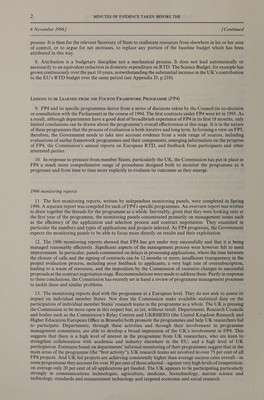
![6 November 1996] [ Continued objectives, reflecting user needs, which seek to address the medium-term technological needs of European industry and to support European policies, including those related to quality of life more broadly. Stronger prioritisation is also needed. 25. It is important that the framework programme’s management structure should support and not impede these aims. Currently, the rigid divisions between different programme areas can reduce its contribution to the achievement of industrial or social goals which depend on a range of technologies. Poor communications between different Directorates-General are a further hampering factor. While the Commission’s task forces were set up in part at least to address this problem, their impact has been reduced both by the way in which they were set up and by the way in which their successful implementation would depend in some cases on cutting across the structures of the existing framework programme and of the Commission. 26. The UK paper seeks to address these issues by recommending that the programme be based on user driven thematic objectives; that the RTD relevant to these objectives be delivered through a small number of technology or policy based programmes; and that a key role be given to users in programme design and oversight. The UK has not at this stage proposed specific objectives, or related S&T priorities, although the position paper provided some illustrative examples. Specific proposals to reflect the UK’s priorities will be elaborated in the light of developments in the negotiations, which are beginning now and will continue through 1998. The continuing evolution of the UK technology foresight priorities will play an important role in guiding UK views in this area. 27. Beyond the RTD programmes (the “first activity”), the UK also attaches importance to the framework programme’s “horizontal” activities. On international co-operation, the UK has consistently argued that the framework programmes should be opened as far as possible to researchers from third countries. In addition, however, there remains a need for an international co-operation programme designed to support financially the participation in the programme of key groups of the EU’s neighbour countries and the developing world. On dissemination and exploitation, the paper argues that a higher priority, and a higher proportion of the budget, should be allocated to the follow-through of funded RTD, particularly through action in the specific programmes. On researcher training and mobility, the paper argues for a greater emphasis to be placed on the involvement of industry. 28. The UK paper indicates that improving the efficiency of programme management, and effective monitoring and evaluation are further important goals of FP5. As described in paragraph 12, there are major problems of bureaucracy and delay that need to be addressed. In particular, there remains scope for shortening timescales for project selection; improving the publicity and advice available to applicants, including making better use of electronic means; fuller transparency in all aspects of the project selection process; reducing interference in the scale and scope of projects while still securing value for money in the contract negotiation process; improving the administration of the measures to encourage SME participation; and reducing oversubscription by improving programme definition and tightening the focusing of calls for proposals. 29. Other member States have declared their priorities for FP5 in their position papers. There is an encouraging convergence of view, particularly among the larger member States, on the fundamentals of a more output oriented, more cost-effective and better managed programme. BALANCE BETWEEN PRE-COMPETITIVE, NEAR MARKET 30. The UK position paper makes clear that, like its predecessors, FPS should focus on objective led applied and strategic RTD. As a matter of principle, the framework programmes should not deal with near- market research and development, which should be left to the market. Nonetheless, pre-competitive demonstration and validation projects, the results of which are made generally‘ available, may play an essential role in achieving exploitation of research results and should therefore come within the scope of the programme. Beyond that, the Eureka framework provides a mechanism for European countries to support collaborative RTD that has moved beyond the pre-competitive stage on the path to market exploitation. While the framework programmes and Eureka have similar goals, ie the reinforcement of Europe’s technology base and improved industrial competitiveness, their roles are complementary and should be kept distinct. 31. The paper also argues that the framework programme should not serve as a funding source for pure basic research as such. This should be the responsibility of member States. In line with the treaty objectives, the role of FP5 should be to develop the technologies needed for competitiveness and quality of life in the medium term and to underpin’Community policies. This implies that the major emphasis should be on applied strategic research. That said, the paper recognises that, where users see long term fundamental research making an essential contribution to programme goals in particular areas, it would be appropriate for such research to be supported. 32. Overall, the paper argues that the broad balance of activities along the RTD spectrum in FP4 should be continued in FP5. The main aim should be to ensure that the programme helps to bring forward the generic](https://iiif.wellcomecollection.org/image/b32218734_0012.jp2/full/800%2C/0/default.jpg)