EU Framework Programme for European research and technological development : evidence / Select Committee on Science and Technology.
- Great Britain. Parliament. House of Lords. Science and Technology Committee.
- Date:
- 1997
Licence: Open Government Licence
Credit: EU Framework Programme for European research and technological development : evidence / Select Committee on Science and Technology. Source: Wellcome Collection.
34/254 page 26
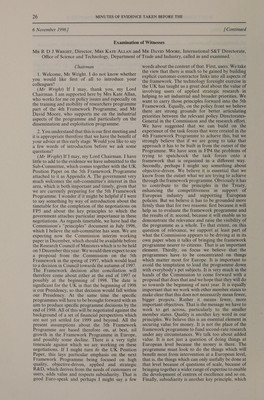
![6 November 1996 ] [ Continued Chairman 1. Welcome, Mr Wright. I do not know whether you would like first of all to introduce your colleagues? (Mr Wright) If I may, thank you, my Lord Chairman. I am supported here by Mrs Kate Allan, who works for me on policy issues and especially on the training and mobility of researchers programme part of the 4th Framework Programme, and Mr David Moore, who supports me on the industrial aspects of the programme and particularly on the dissemination and exploitation programme. 2. You understand that this is our first meeting and it is appropriate therefore that we have the benefit of your advice at this early stage. Would you like to say a few words of introduction before we ask some questions? (Mr Wright) If may, my Lord Chairman. I have little to add to the evidence we have submitted to the Sub-Committee, which comes together with the UK Position Paper on the Sth Framework Programme attached to it as Appendix A. The government very much welcomes the sub-committee’s interest in this area, which is both important and timely, given that we are currently preparing for the Sth Framework Programme. I wonder if it might be helpful if I were to say something by way of introduction about the timetable for the completion of the negotiations on FPS and about the key principles to which the government attaches particular importance in these negotiations. As regards timetable, we have had the Commission’s “principles” document in July 1996, which I believe the sub-committee has seen. We are expecting now the Commission interim working paper in December, which should be available before the Research Council of Ministers which is to be held on 5 December this year. We would then expect to see a proposal from the Commission on the 5th Framework in the spring of 1997, which would lead to a decision in Council towards the autumn of 1997. The Framework decision after conciliation will therefore come about either at the end of 1997 or possibly at the beginning of 1998. The date is significant for the UK in that the beginning of 1998 is our Presidency, so that decision would fall within our Presidency. At the same time the specific programmes will have to be brought forward with an aim to produce specific programme decisions by the end of 1998. All of this will be negotiated against the background of a set of financial perspectives which are not yet settled for 1999 and beyond. All the present assumptions about the Sth Framework Programme are based therefore on, at best, nil growth in the Framework Programme in Europe, and possibly some decline. There is a very tight timescale against which we are working on these negotiations. If I might turn to the UK Position Paper, this lays particular emphasis on the next Framework Programme being focused on high quality, objective-driven, applied and _ strategic R&D, which derives from the needs of customers or users, adds value and respects subsidiarity. That is good Euro-speak and perhaps I might say a few words about the content of that. First, users. We take the view that there is much to be gained by building explicit customer-contractor links into all aspects of the framework. The technology foresight exercise in the UK has taught us a great deal about the value of involving users of applied strategic research in helping to set industrial and broader priorities. We want to carry those principles forward into the Sth Framework. Equally, on the policy front we believe there are strong grounds for better articulating — priorities between the relevant policy Directorates- We have suggested that we can build on the experience of the task forces that were created in the 4th Framework Programme to achieve this, but we strongly believe that if we are going to take that approach it has to be built in from the outset of the Programme. We have seen in FP4 the problems of trying to spatchcock the task forces onto a framework that is organised in a different way. Secondly, perhaps I might say something about objective-driven. We believe it is essential that we know from the outset what we are trying to achieve through the framework programme. Obviously it has to contribute to the principles in the Treaty, enhancing the competitiveness in support of European industry and supporting European policies. But we believe it has to be grounded more firmly than that for two reasons: first because it will help us to evaluate the framework programme and the results of it; second, because it will enable us to demonstrate the relevance and raise the visibility of the programme as a whole. To that extent, on this question of relevance, we support at least part of what the Commission appears to be driving at in its own paper when it talks of bringing the framework programme nearer to citizens. That is an important element. Thirdly, on focus we believe that the programmes have to be concentrated on things which matter most for Europe. It is important to avoid the temptation to load the programme down with everybody’s pet subjects. It is very much in the hands of the Commission to come forward with a proposal that does that and we hope that they will do so towards the beginning of next year. It is equally important that we work with other member states to make clear that this does not necessarily mean fewer, bigger projects. Rather it means fewer, more important objectives. That is the message we have to work to get across, particularly to the smaller member states. Quality is another key word in our principles. We believe this is an essential element in securing value for money. It is not the place of the framework programme to fund second-rate research under any circumstances. We talk too about added value. It is not just a question of doing things at European level because the money is there. The programme must look to do the things which will benefit most from intervention at a European level, that is, the things which can only usefully be done at that level because of questions of scale, because of bringing together a wider range of expertise to enable the development of centres of excellence and so on, Finally, subsidiarity is another key principle, which](https://iiif.wellcomecollection.org/image/b32218734_0034.jp2/full/800%2C/0/default.jpg)