[Report 1956] / School Medical Officer of Health, Oxford City.
- Oxford (England). City Council. no2012034102.
- Date:
- 1956
Licence: Attribution 4.0 International (CC BY 4.0)
Credit: [Report 1956] / School Medical Officer of Health, Oxford City. Source: Wellcome Collection.
10/64 page 8
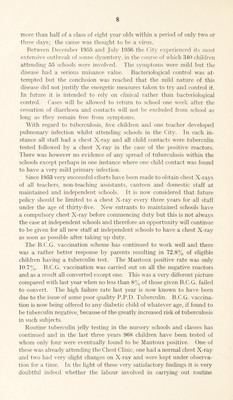
![more than half of a class of eight year olds within a period of only two or three days; the cause was thought to be a \unis. Between December 1955 and July 1955 the C'it}^ ex])erienced its most extensive outbreak of sonne dysentery, in the course of which 340 children attending 55 schools were involved. The symptoms were mild but the disease had a serious nuisance value. Bacteriological control was at¬ tempted but the conclusion was reached that the mild nature of this disease did not justify the energetic measures taken to try and control it. In future it is intended to rely on clinical rather than bacteriological control. Cases will be allowed to return to school one week after the cessation of diarrhoea and contacts will not be excluded from school as long as they remain free from sym])toms. With regard to tuberculosis, five children and one teacher developed pulmonary infection whilst attending schools in the City. In each in¬ stance all staff had a chest X-ray and all child contacts were tuberculin tested followed by a chest X-ray in the case of the positive reactors. There was however no evidence of any spread of tuberculosis within the schools except perhaps in one instance where one child contact was found to have a very mild primary infection. Since 1953 very successful efforts have been made to obtain chest X-rays of all teachers, non-teaching assistants, canteen and domestic staff at maintained and independent schools. It is now considered that future policy should be limited to a chest X-ray every three years for all staff under the age of thirty-five. New entrants to maintained schools have a compulsory chest X-ray before commencing duty but this is not always the case at independent schools and therefore an opportunity will continue to be given for all new staff at independent schools to have a chest X-ray as soon as possible after taking up duty. The B.C.G. vaccination scheme has continued to work well and there was a rather better response by parents resulting in 72.8% of eligible children having a tuberculin test. The Mantoux positive rate was only 10.7%. B.C.G. vaccination was carried out on aU the negative reactors and as a result all converted except one. This was a very different picture compared with last year when no less than 8% of those given B.C.G. failed to convert. The high failure rate last year is now known to have been due to the issue of some poor quality P.P.D. Tuberculin. B.C.G. vaccina¬ tion is now being offered to any diabetic child of whatever age, if found to be tuberculin negative, because of the greatly increased risk of tuberculosis in such subjects. Routine tuberculin jelly testing in the nursery schools and classes has continued and in the last three years 968 children have been tested of whom only four were eventually found to be Mantoux positive. One of these was already attending the Chest Clinic, one had a normal chest X-ray and two had very slight changes on X-ray and were kept under observa¬ tion for a time. In the light of these very satisfactory findings it is very doubtful indeed whether the labour involved in carrying out routine](https://iiif.wellcomecollection.org/image/b29942834_0010.jp2/full/800%2C/0/default.jpg)