[Report 1956] / School Medical Officer of Health, Oxford City.
- Oxford (England). City Council. no2012034102.
- Date:
- 1956
Licence: Attribution 4.0 International (CC BY 4.0)
Credit: [Report 1956] / School Medical Officer of Health, Oxford City. Source: Wellcome Collection.
42/64 page 40
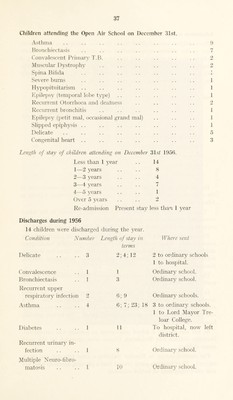
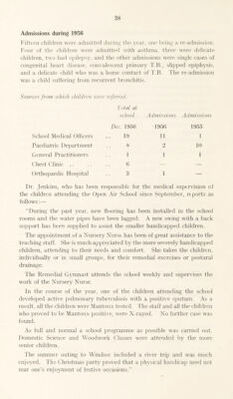
![bo rifj^id in the u])per or lower limits in the case of an individual child- The experimental nature of the class must be emphasized, and what will hap])en to children outgrowing the class, whether their residual hearing will be suhiciently well-trained for them to take their place in an ordinary school or whether transfer to a special residential school will be necessary will be determined very largely by the criteria used in selecting the children in the hrst place. HEART DISEASE IN SCHOOL CHILDREN Dr. Wdgheld has contributed the following note as a continuation of the article on this subject appearing in last year’s Annual Report. ‘'At the end of 1955 there were 18 children with congenital heart defects and 10 with heart defects due to rheumatic fever, attending Oxford City schools. Of these, 6 with congenital and 2 with rheumatic defects are likely to be substantially handicapped in the future. During the year 6 children with cardiac defects left school. 4 of these were notified to the employment exchange as handicapped persons but this was not necessary for the remaining 2 as they were able to undertake full exertion. 4 children had rheumatic fever or chorea during the year which necessitated restriction of their P.T. and games. This is done under the guidance of the Consultant at the Radcliffe Infirmary. Arrangements are also made for children whose activity is curtailed for any reason to be seen annually by a school medical officer so that the restrictions can be reviewed. At the end of the school year there were 20 children under observation by the school doctors for possible heart defect, some pending investigation by the consultant. Last year there were 28 similar cases under observa¬ tion. Of these 19 were found to have no abnormality, and 2 were diagnosed by a consultant to have a congenital heart defect. A further child has left Oxford, and the family doctor of another advised against investigation. 5 are still under investigation, no decision having been reached. As a general rule, children with congenital heart defects are not restricted in activity except for very strenuous games and competitive sports where they can over-tax the heart. Children convalescent from rheumatic fever pass through graded increases in activity which usually allow them to return to normal exertions within 2 years of the illness. It is important to allow life to be as normal as possible for the children within these limit¬ ations, and also to ensure that there is the minimum interruption of their schooling. To this end teaching is provided at the Marlborough Con- \'alescent Home or alternatively a home teacher may be provided by the local authority. The provision of transport to take them to school, part- time schooling, and the less strenuous regime of the Open Air School are also of help during the early stages of recovery from rheumatic fever.”](https://iiif.wellcomecollection.org/image/b29942834_0042.jp2/full/800%2C/0/default.jpg)