On human muscle as a transformer of energy / John G. McKendrick.
- McKendrick, John G. (John Gray), 1841-1926.
- Date:
- [1891]
Licence: Public Domain Mark
Credit: On human muscle as a transformer of energy / John G. McKendrick. Source: Wellcome Collection.
Provider: This material has been provided by The University of Glasgow Library. The original may be consulted at The University of Glasgow Library.
3/28
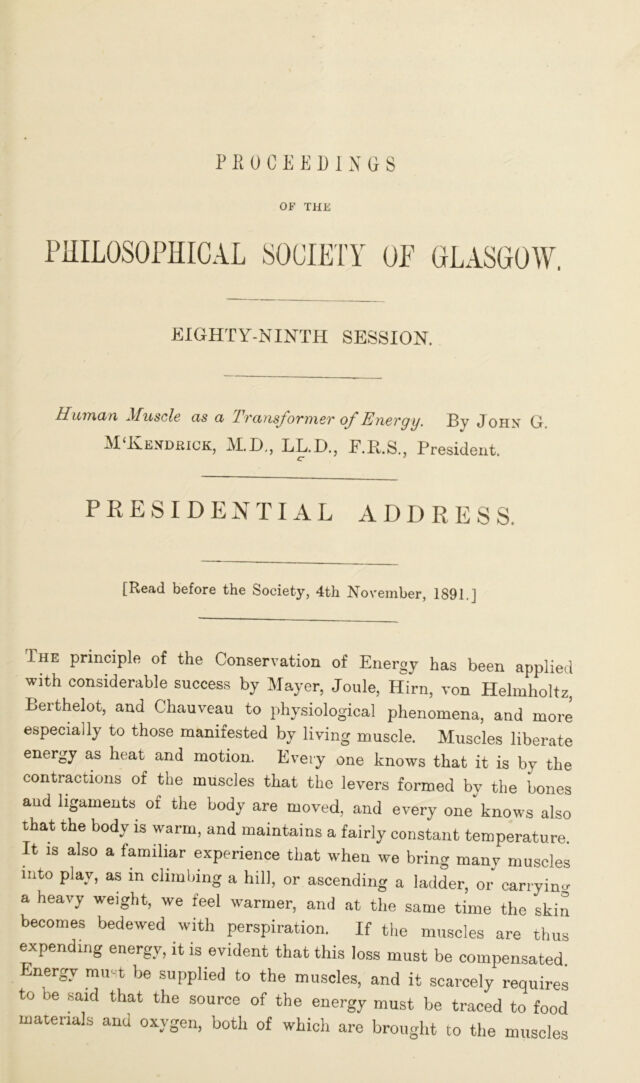
![PROCEEDINGS OF THE PHILOSOPHICAL SOCIETY OF GLASGOW. EIGHTY-NINTH SESSION. Human Muscle as a Transformer of Energy. By John G. M‘Hendrick, M.D., LL.D., F.R.S., President. c J PRESIDENTIAL ADDRESS. [Read before the Society, 4th November, 1891.] The principle of the Conservation of Energy has been applied with considerable success by Mayer, Joule, Hirn, von Helmholtz, Berthelot, and Chauveau to physiological phenomena, and more especially to those manifested by living muscle. Muscles liberate energy as heat and motion. Every one knows that it is by the contractions of the muscles that the levers formed by the bones and ligaments of the body are moved, and every one knows also that the body is warm, and maintains a fairly constant temperature. It is also a familiar experience that when we bring many muscles into play, as in climbing a hill, or ascending a ladder, or carrying a heavy weight, we feel warmer, and at the same time the skin becomes bedewed with perspiration. If the muscles are thus expending energy, it is evident that this loss must be compensated. Energy mint be supplied to the muscles, and it scarcely requires to be said that the source of the energy must be traced to food materials and oxygen, both of which are brought to the muscles](https://iiif.wellcomecollection.org/image/b24930143_0005.jp2/full/800%2C/0/default.jpg)