The prescription : therapeutically, pharmaceutically, and grammatically considered / by Otto A. Wall.
- Otto Augustus Wall
- Date:
- 1888
Licence: Public Domain Mark
Credit: The prescription : therapeutically, pharmaceutically, and grammatically considered / by Otto A. Wall. Source: Wellcome Collection.
Provider: This material has been provided by the Francis A. Countway Library of Medicine, through the Medical Heritage Library. The original may be consulted at the Francis A. Countway Library of Medicine, Harvard Medical School.
71/200 (page 61)
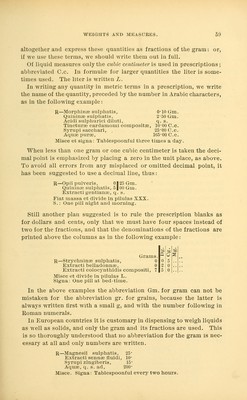
![To realize this relationship, it will be well to carefully compare the scale of one decimeter and its subdivisions with the scale of four inches and its subdivsions in the accompanying figure. ENGLISH 1 2 ill ill ill ill INCHES. 3 '^ ill ill ill ill MM MM Mil Mil III! III! MM Mil {lllllll liiliiii! nil Mil IIIIIMII lllllllll MM III! ' 2 1 DE 3 CIMETI 1 1 'I- 5 6 ]R = 10 CENTIMETERS = 7 6 9 = 100 MILLIMETERS. 10 Next we try to realize and memorize measures of capacity. The scale representing one decimeter in the above figure serves to con- struct a measure of capacity. A cubic decimeter is one liter, as al- ready explained. Equivalents of Fluid Measure. 15 miniina = about 1 cubic centimeter. 1 fluidram = about 4 cubic centimeters. 1 fluidounce = about 30 cubic centimeters. 1 pint = about 0*5 liter, or 500 cubic centimeters. 1 quart = about 1 liter, or 1,000 cubic centimeters. Equivalents of Weight. 1 grain = about 0-06 gram, or 6 centigrams. 15 grains = about 1 gram. 1 dram = about 4 grams. 1 troy ounce = about 30 grams. For use in learning to construct a metric prescription, it becomes necessary to adopt some easy rules for conversion from apothecaries' to metric weights. The simplest method is as follows: Multiply ounces by 30 to get the number of grams. Multiply drams by 4 to get the number of grams. When there are less than 60 grains divide by 15 to ascertain the number of grams. If there is a remain- der, or if the number of grains is less than 16, we may reduce to fractions of a gram, as follows: Assume the gram {written 1-00 Ghn.) to be equal to 15 or 16 grains. To convert any number of grains less than 16 into centigrams, think what fraction that number is of 15 or 16, as may be most convenient, and, then take that fractional part of I'OO gram to express the metric equiva- lent, ignoring fractions beyond the second decimal place. The following will make this clear: 1 grain 2 grains 3 grains 4 grains 5 grains 6 grains 8 grains 9 grains 10 grains 12 grains : Vieof V8 Of 1/5 Of 1/4 Of 1/3 Of 2/5 Of 1/2 Of 3/5 Of 2/3 Of 3/4 of 16 grains: 16 grains: 15 grains: 16 grains: 15 grains 15 grains: 16 grains: 15 grains: 15 grains: 16 grains; 1/16 of 1 1/8 Ofl 1/5 Of 1 1/4 Ofl 1/g ofl 2/5 ofl 1/2 Ofl 3/5 Ofl 2/3 Ofl 3/4 ofl 00 gram • 00 gram • 00 gram • 00 gram •00 gram • 00 gram •00 gram • 00 gram • 00 gram • 00 gram 06 gram. 12 gram. 20 gram. 25 gram. 33 gram. 40 gram. 50 gram. 60 gram. 66 gram. 75 gram.](https://iiif.wellcomecollection.org/image/b21083034_0071.jp2/full/800%2C/0/default.jpg)