The bronchi and pulmonary blood-vessels : their anatomy and nomenclature, with a criticism of Professor Aeby's view on the bronchial tree of mammalia and of man / by William Ewart.
- William Ewart
- Date:
- 1889
Licence: Public Domain Mark
Credit: The bronchi and pulmonary blood-vessels : their anatomy and nomenclature, with a criticism of Professor Aeby's view on the bronchial tree of mammalia and of man / by William Ewart. Source: Wellcome Collection.
Provider: This material has been provided by The University of Leeds Library. The original may be consulted at The University of Leeds Library.
267/308 page 203
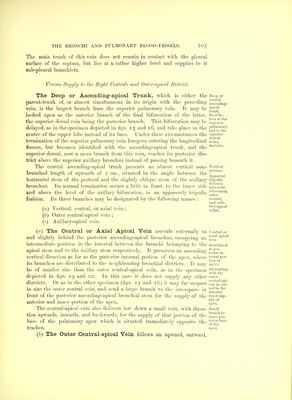
![The Sub-pleural Posterior Ascending-apical Vein lies behind sub piemai the preceding vein, and, instead of being, like it, almost vertical, arches asceudhio-- backwards across the inner surface of the rising apical arterial stem, iust above Y.*^^^ . . —supplies the line of pleural reflection which is seen on this surface, and slightly above the pos- the arch of the azygos vein. It distributes superficial veins to the internal ferJorpart base and to the posterior base of the apex. surfacro' apex. The vertical line of the superficial inner ascending pulmonary vein and The super- of its branches defines with precision the anterior boundary of the root of the HsceucUug lung, and also, hio-lier up. the internal boundary of the apex. At the level 7^^ of the upper lobar bronchus, just before it finally bifurcates, the vein is the of four innermost of a row of four large apical ascending trunks, the second trunk aplcai'^^ being the ascending-apical artery, the third the bronchus, and the fourth ''i^s. the intra-apical ascending-apical vein. Tiie close proximity and parallelism of the vein to the artery in this case constitutes an interesting exception to the rule of dissociation which usually governs the relations of the two vessels. The terminations of the two superior divisions of the vein are chiefly snb- Termiuai pleural. They may however to a slight depth supply the pulmonary tissue chje^y s^„b- also. Their injection has unfortunately been incomplete in the metallic pleural, casts. But in the latter the two bronchial districts in question are seen to receive their deep venous supply mainly from branches of the intra-apical ascending vein. Venous Supplij to the Right Pectoral Eegioii. The remaining branches of the superior pulmonary vein, with the excep- The other tion of the deep ascending apical trunk, are situated very superficially, close superh!i^ °^ to the inferior surface of the upper lobe, and to the upi^er pleural linino- of P!''?'^='»t ^ t ' . iii vein form the transverse fissure and 01 the superior part of the longitudinal fissure i^i^ outer respectively. Thus three of the sides of the upper lobe are outlined by pul- tiie'upper monary veins, the bronchial and arterial tree bein^ contained within them as 1?''° , *j ' ^ o turee sides. an outer framework connected with the pulmonary pleura. The Mid-sternal Pectoral Vein is a stout vessel, I 8 cm. in Mid-storual length, originating straight forward from the inferior and anterior aspect of vdn?'is!,- the convexity of the suijerior pulmonary vein. In the metallic cast it forms . . . J- 1 autenor m- tlie anterior inferior angle of the upper lobe, at a distance of i-8 cm. below feriorangie, the level of the sterno-pectoral bronchus, for the district of which its ascend- thTdislrict insf branch is destined. °^ steruo- . . . . . pectoral Occupying a solitary and peripheral position in the midst of the spongy bronchus, tissue of the pulmonary angle above described, it distributes numerous vessels Jounection ])erpendicular to the surface and through them it enters into relation with ^ith three three pleural surfaces, the mesial or mediastinal, the anterior or thoracic, and surfaces, the inferior or interlobar surface of the upper lobe. ^^'^ brauclies.](https://iiif.wellcomecollection.org/image/b21518701_0267.jp2/full/800%2C/0/default.jpg)