The bronchi and pulmonary blood-vessels : their anatomy and nomenclature, with a criticism of Professor Aeby's view on the bronchial tree of mammalia and of man / by William Ewart.
- William Ewart
- Date:
- 1889
Licence: Public Domain Mark
Credit: The bronchi and pulmonary blood-vessels : their anatomy and nomenclature, with a criticism of Professor Aeby's view on the bronchial tree of mammalia and of man / by William Ewart. Source: Wellcome Collection.
Provider: This material has been provided by The University of Leeds Library. The original may be consulted at The University of Leeds Library.
43/308 page 19
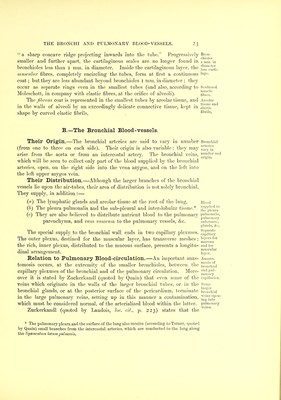
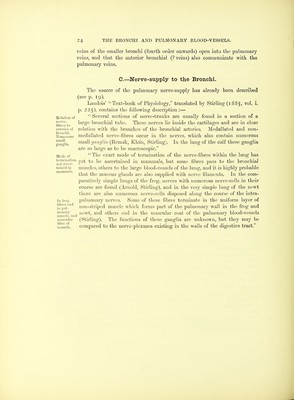
![Dybkowski (Arbeiten aus der Pliysiolog., Anstalt in Leipzig, 1866) stomata had previously described the existence of stomata in the parietal pleura: ^li^.u!..*^*'^^ these stomata are stated to be absent from the pleura which covers the ribs, although present in their interspaces. [The following observations, quoted by Landois (Text-book of Physio- logy, Stirling's translation, vol. i. p. 224, 1883) refer to the fine anatomy of the intra-pulmonary system :— According to Pierret and Kenaut every air-cell of tlu' lung of the ox i>s surrounded by a large lymph space, such as occurs in the salivary glands. Nothnagel found that, if blood was sucked into the lung of a rabbit, the Ripid blood corpuscles were discovered within the interstitial connective-tissue of ex\'rav- of the lung after 35-5 minutes, and he concludes that the communica- s^tedbioi d, tions between the cavity of the air-cells and the lymphatics must be very numerous. According to Klein, jmudo-stomafr/, opening into the canaliculi, exist in Tsoudo- the cement-substance uniting the epithelial cells of tlie alveolus : they are between most easily seen in the distended air-cell. They would afford passage for lymph corpuscles and particles of pigment; but according to v. Wittich denipd the latter are independent of any pre-existing apertures and make their way through the soft semi-flnid cement-substance.] Intra-alveolar Channels.—Wiwodzoff (Wiener Med. Jahrb., Bd. xi. 1866). quoted by Klein (hie. cif.. p. 29), describes, in the connective-tissue of the alveoli of dogs and horses, small lymph canals, the larger of which run parallel to the elastic fibres, and then follow the course of the capillary blood-vessels, but in many cases cross the latter, and in their meshes become Cauaiiruii confluent, so as to form lacamr. kciuia'. Sikorsky (Centralblatt fiir Med. Wiss., No. 52, 1870), quoted by Klein Qoc. cit.), likewise described canaliculi and lacume, the latter being situated at the nodes where the canaliculi anastomose, and exclusively in the meshes between capillary blood-vessels. Gr.—The Nerve-supply to the Lungs. An anterior and a posterior pulmonary i)Je:cvs are stated to be formed by Anfevioi- branches of the vagus in association with symjmthctic fibres ; and their branches lerior*^ enter the root of the lung and accompany the bronchial divisions. Remak, pidmouary and subsequently Stirling, have described in connection with these nerves, solitary and grouped ganglia of minute size. The pulmonary branches of the vagus are divided by Quain into two sets, Pulmonary distributed to the anterior and to the posterior aspect of the root of the lung, from v^^s: '■ The anterior pulmonary nerves, two or three in number, are of snuiU size. autcTiov. They join with filaments of the sympathetic ramifying on the pulmonary ; artery, and with these nerves constitute the anterior pulmonary plexus.](https://iiif.wellcomecollection.org/image/b21518701_0043.jp2/full/800%2C/0/default.jpg)
 No text description is available for this image
 No text description is available for this image
 No text description is available for this image