The bronchi and pulmonary blood-vessels : their anatomy and nomenclature, with a criticism of Professor Aeby's view on the bronchial tree of mammalia and of man / by William Ewart.
- William Ewart
- Date:
- 1889
Licence: Public Domain Mark
Credit: The bronchi and pulmonary blood-vessels : their anatomy and nomenclature, with a criticism of Professor Aeby's view on the bronchial tree of mammalia and of man / by William Ewart. Source: Wellcome Collection.
Provider: This material has been provided by The University of Leeds Library. The original may be consulted at The University of Leeds Library.
61/308 page 37
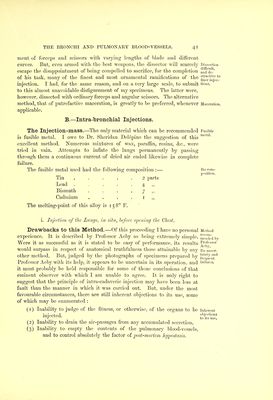
![All the branches of the left bronchus are therefore situated below tlie Left lateral artery ; they are therefore termed liijyavtcrial. The right bronchus on the u'j°p||'j.. contrary is crossed by the artery aflcr delivering its first branch. The pj^,'/!,,.^^ pulmonary artery thus separates the branches arising from the right bronchus clji eiiai-- into two sets, one of which is liiipartcriul^ the other qmrtcrud. hypar-^'^ 7. Instances of Complete Symmetry, in Animals.—In a few mammalia the arrangement is symmetrical on both sides, owing to a presence symmetrical passage of the pulmonary artery; and in them both lungs ^^k?'' possess an cvarterial and an Inmaricrud set of bronchial branches. This system in some arrangement is never seen m man. mammals. 8. Pure Hyparterial Type.—In one genus only (Hystrix cristata, itsbiiatcmi tho hedge-hog), symmetry of an opposite kind obtains. In this animal ny^lj'i'ix^ neither the right nor the left bronchus bears any branches superior to the pulmonary arter}^ Both its lungs are entirely l\]ii>artvru{l. 9. Eparterial and Hyparterial Distribution.—In respect of their ventral and dorsal branches the eparterial and the hyparterial districts show a marked contrast. Whereas in the hyparterial the ventral and the dorsal branches arise separately from the bronchial stem, in the eparterial system they coalesce into a single eparterial trunk (the right upper lobar bronchus). 10. Upper Right and Upper Left Lobe not Analogous.— Upper left Inasmuch as in man and in most mammalia the left lung does not possess an va'ieutTo eparterial district corres2)onding to the right upper lobe, the superior of the ^^f^^'^ ^ two left pulmonary lobes, being hyparterial, is the e(j%dxcdent not of the right ^f^^^^ upper lobe, or eparterial lobe, but of therie/Jit middle lohe which is hyparterial. ^ But the left inferior lobe exactly corresponds with the right lower lobe. ^ 11. Mixed Type.—The human lungs are an instance of a mixed type Mixedtypo in which only one lung contains an eparterial district. 12. Eparterial Type.—The presence in some animals of a left Eparterial eparterial bronchus in addition to a right eparterial bronchus gives rise, in tCThUyprs them, to the true c2Xfrtericd< type. 13. Hyparterial Type.—The absence of both eparterial branches, where it occurs (in Hystrix cristata) constitutes the true hypctrteried type, which may be looked upon as the lowest morphological expression in mammalian pulmonary architecture. 14. Lateral and Accessory Bronchi.—In man the right and the iw left hyparterial districts are almost identical, each possessing about four ventral bronchi ■ and four dorsal branches, in addition to some accessory bronchi. four dorsal; and some 15. The Left, a Diminished Lung.—The right human lung pos- accessory, sesses, in its eparterial lobe, an additional district, non-existent in the left ^''f'^'™^ ' >■ ' ... possesses lung; in other words, the left lung is deficient in a true upper lobe, such uoopar- as would belong to the complete eparterial type of lungs. upper lobe. Criticism.—Such, in bare outline is Aeby's ingenious theory, which strong](https://iiif.wellcomecollection.org/image/b21518701_0061.jp2/full/800%2C/0/default.jpg)
 No text description is available for this image
 No text description is available for this image
 No text description is available for this image