Natural history in Shakespeare's time : being extracts illustrative of the subject as he knew it / Made by H. W. Seager, M. B., &c. Also pictures thereunto belonging.
- Seager, H. W. (Herbert West), 1848-
- Date:
- 1896
Licence: Public Domain Mark
Credit: Natural history in Shakespeare's time : being extracts illustrative of the subject as he knew it / Made by H. W. Seager, M. B., &c. Also pictures thereunto belonging. Source: Wellcome Collection.
Provider: This material has been provided by the Harvey Cushing/John Hay Whitney Medical Library at Yale University, through the Medical Heritage Library. The original may be consulted at the Harvey Cushing/John Hay Whitney Medical Library at Yale University.
29/376 (page 17)
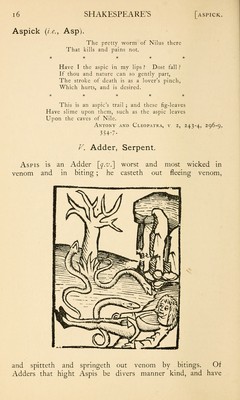
![diverse effects and doings to noy and to grieve, that is to wit, Dipsas,—when he biteth, he slayeth with thirst. Ipalis is a manner Adder that slayeth with sleep. These manner Adders Cleopatra laid by her, and passed out of the life by death as it were by sleep. And there be many other Adders, and the venom of them is so strong, that they slay with their venom him that toucheth them with a spear. The Adder Aspis, when she is charmed by the enchanter, to come out of her den by charms and conjurations, for she hath no will to come out, layeth her one ear to the ground, and stoppeth that other with her tail, and so she heareth not the voice of the charming, nor cometh out to him that charmeth, nor is obedient to his saying—[ the deaf adder that stoppeth her ears, and refuseth to hear the voice of the charmer, charm he never so wisely]. This slaying Adder and venomous hath wit to love and affection, and loveth his make [mate] as it were by love of wedlock, and liveth not well without company. Therefore if the one is slain, the other pursueth him that slew that other with so busy wreak and vengeance that passeth weening. And knoweth the slayer, and reseth on him, be he in never so great company of men and of people, and busieth to slay him, and passeth all difficulties and spaces of ways, and with wreak of [will wreak] the said death of his make. And is not let ne put off, but it be by swift flight, or by waters or rivers. But against his malice kind giveth remedy and medicine. For kind giveth him right dim sight ; for his eyes are set in the sides of his head, and be not set in the forehead ; and therefore he may not see his adversary forthright, but aside. Therefore he may not follow his enemy by sight, but he foUoweth more by hearing and smell ; for in these two wits he is strong and mighty. This Adder Aspis grieveth not men of Africa and Moors ; for they take their children that they have suspect, and put them to these Adders : And if the children be of their kind this Adder Aspis grieveth them not : And if they be of other kind anon he dieth by venom of the Adder. These beasts slay strangers and men of other lands. And these serpents spare wonderly men that be born in the same land. So the serpent Anguis about the River Euphrates grieveth not nor hurteth men of the land ; nor noyeth them that sleep, if they be of that land, and pain and slay busily other men, 2](https://iiif.wellcomecollection.org/image/b2100433x_0029.jp2/full/800%2C/0/default.jpg)