Natural history in Shakespeare's time : being extracts illustrative of the subject as he knew it / Made by H. W. Seager, M. B., &c. Also pictures thereunto belonging.
- Seager, H. W. (Herbert West), 1848-
- Date:
- 1896
Licence: Public Domain Mark
Credit: Natural history in Shakespeare's time : being extracts illustrative of the subject as he knew it / Made by H. W. Seager, M. B., &c. Also pictures thereunto belonging. Source: Wellcome Collection.
Provider: This material has been provided by the Harvey Cushing/John Hay Whitney Medical Library at Yale University, through the Medical Heritage Library. The original may be consulted at the Harvey Cushing/John Hay Whitney Medical Library at Yale University.
332/376 (page 320)
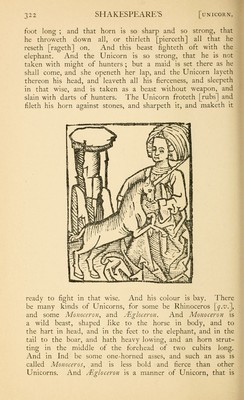
![The Turquoise is formed beyond the farthest parts of India among the inhabitants of the mountain Caucasus, [and in] Carmania. They be found in icy cliffs hardly accessible, where you shall see them bearing out after the manner of bosses like unto eyes. Holland's Pliny, bk. xxxvii. ch. viii. A TRUE wife should be like a Turquoise stone, clear in heart in her husband's health, and cloudy in his sickness. Alex Kicholas^ Discourse of Marriage and Wiving, ch. xiv. § 18. And true as Turquoise in the dear lord's ring Look well or ill with him. Ben Jonson, Sejanus, i. i. The Turquoise, which who haps to wear Is often kept from peril. D}-ayton, Muses' Elysium. The Turquoise doth move, when there is any peril pre- pared to him that weareth it. Eihv. Fenton, Sccr<;t Wonders of Nature. The Turquoise is likewise said to take away all enmity, and to reconcile man and wife. Thos. Nicols, Lapidary. [These three quotations are from Steevens' notes to the passage in *' Merchant of Venice.] Turtle, Turtle-dove. Winter's Tale, iv. 4, 154. Merry Wives of Windsor, iii. 3, 44. i. King Henry VI., ii. 2, 30. The Turtle hath that name of the voice, and is a simple bird as the culvour, but is chaste, far unlike the culvour, and if he loseth his make [i.e., mate], he seeketh not com- pany of any other, but goeth alone, and hath mind of the^ fellowship that is lost, and groaneth alway, and loveth andi chooseth solitary places, and flieth much company of men](https://iiif.wellcomecollection.org/image/b2100433x_0332.jp2/full/800%2C/0/default.jpg)