Natural history in Shakespeare's time : being extracts illustrative of the subject as he knew it / Made by H. W. Seager, M. B., &c. Also pictures thereunto belonging.
- Seager, H. W. (Herbert West), 1848-
- Date:
- 1896
Licence: Public Domain Mark
Credit: Natural history in Shakespeare's time : being extracts illustrative of the subject as he knew it / Made by H. W. Seager, M. B., &c. Also pictures thereunto belonging. Source: Wellcome Collection.
Provider: This material has been provided by the Harvey Cushing/John Hay Whitney Medical Library at Yale University, through the Medical Heritage Library. The original may be consulted at the Harvey Cushing/John Hay Whitney Medical Library at Yale University.
333/376 (page 321)
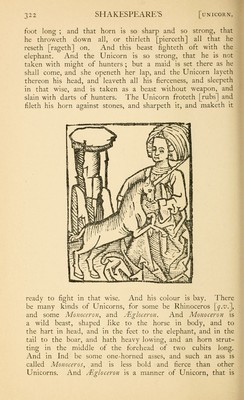
![\_TroilHs and Cressida, iii. 2, 185, and Winters Tale^ ut supra]. He cometh in springing time and warneth of novelty of time with groaning voice. And in winter he loseth his feathers, and then he hideth him in hollow stocks. And against summer, in springing time, when his feathers spring again, he cometh out of his hole in the which he was hid, and seeketh convenable place and stead for to breed in. The Turtle layeth eggs twice in springing time, and not the third time, but if the first eggs be corrupt. Also the blood of her right wing is medicinable, as the blood of a swallow, and of a culvour or dove. Bartkolomew [Bertkelet), bk. xii. § 34. Amatides is a precious stone ; if a cloth be touched therewith, the cloth withstandeth fire and burneth not, though it be put therein ; but it receiveth brightness and seemeth the more clear. And withstandeth all evil doing of witches. Ibid., bk. xvi. § 19. It is supposed that in the maw of the cock Turtle-dove this stone is to be found, and hath virtue to increase concord and love. Batman^s addition to Bartholomezv, ut supra. If the heart of a Turtle-dove be worn in the skin of a wolf, the wearer will never thenceforth be wanton. If its heart be burnt, and put on the eggs of any bird, never will it be possible that they should be hatched. And if its feet be hung on a tree, from thenceforth it will not bear fruit. And if a hairy place be anointed with its blood, and the water in which a mole has been boiled, the black hairs will fall off. Albertus Magnus, Of the Virtues of Animals. Unicorn. A living drollery ! Now I will believe That there are unicorns. Tempest, iii. 2, 22. Julius C^sar, ii. i, 204. An Unicorn is a right cruel beast, and hath that name for he hath in the middle of the forehead an horn of four 21](https://iiif.wellcomecollection.org/image/b2100433x_0333.jp2/full/800%2C/0/default.jpg)