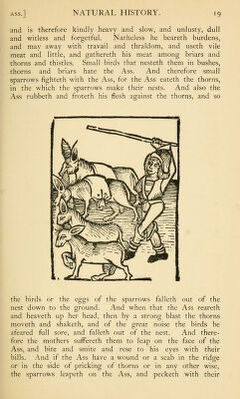
Natural history in Shakespeare's time : being extracts illustrative of the subject as he knew it / Made by H. W. Seager, M. B., &c. Also pictures thereunto belonging.
- Seager, H. W. (Herbert West), 1848-
- Date:
- 1896
Licence: Public Domain Mark
Credit: Natural history in Shakespeare's time : being extracts illustrative of the subject as he knew it / Made by H. W. Seager, M. B., &c. Also pictures thereunto belonging. Source: Wellcome Collection.
Provider: This material has been provided by the Harvey Cushing/John Hay Whitney Medical Library at Yale University, through the Medical Heritage Library. The original may be consulted at the Harvey Cushing/John Hay Whitney Medical Library at Yale University.
35/376 (page 23)
![Barnacles. We shall lose our time, And all be turn'd to barnacles. Tempest, iv. i, 248-50. I TOLD them of as great a marvel to them that is amongst us : and that was of the Barnacles. For I told them that in our country were trees that bear a fruit that become birds flying : and those that fall in the water live : and they that fall on the earth die anon : and they be right good to man's meat. And hereof had they a great marvel, that some of them trowed it were an impossible thing to be. Sir John Mandeville, ch. xxvi. In the Islands of Ireland, and Orcades, in certain places there, there be certain trees, much like unto willow-trees, out of which come forth certain little hairs, increasing by little and little into birds, having shape of ducks, hanging upon the bough by their nebs or bills ; and when they are come to full perfectness, they fly away of themselves, or fall into the next seas, which birds we call Barnacles. This is related by the people that dwell there. Luptoti's Notable Things, bk. vii. § 3. [Gerard in his Herbal gives a description o{ the Barnacle or Goose-tree, too long to quote, but he declares that he has seen it, and vouches for it of his own knowledge.] In Man they have great store of Barnacles breeding upon their coasts. [He adds that he sought vainly for Barnacles until May, 1584, when he found many shells on ships in the Thames newly come home from Barbary or the Canary Isles, and on opening them he] saw the proportion of a fowl in one of them, saving that the head was not yet formed, because the fresh water had killed them all (as I take it). Certainly the feathers of the tail hang out of the shell at least two inches, the wings almost perfect, touching form, so that it cannot be denied but that some bird or other must proceed of this substance. Hnrrisori's Description of Britain, p. 38, in Holinsked. One little fish [Remora or Barnacle], not above half a foot long, is able to arrest and stay perforce, yea and hold as prisoners our goodly tall and proud ships. This little fish detained Caligula's ship (a galliass it was, furnished](https://iiif.wellcomecollection.org/image/b2100433x_0035.jp2/full/800%2C/0/default.jpg)