The discovery of the nature of the spleen : from an investigation of the lateral homologies of the liver, stomach, and intestinal canal / by Henry R. Silvester.
- Silvester, Henry R. (Henry Robert), 1829-1908.
- Date:
- 1870
Licence: Public Domain Mark
Credit: The discovery of the nature of the spleen : from an investigation of the lateral homologies of the liver, stomach, and intestinal canal / by Henry R. Silvester. Source: Wellcome Collection.
Provider: This material has been provided by The Royal College of Surgeons of England. The original may be consulted at The Royal College of Surgeons of England.
3/64
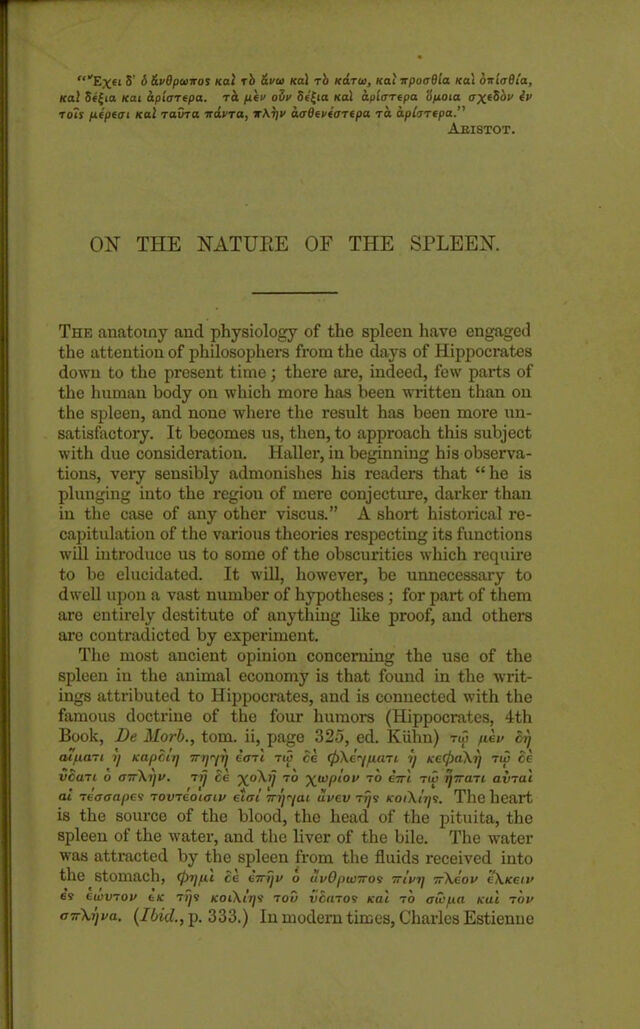
!['Exfi 5' & &v6p<M>Tros Kal rh ficeo koI t!) kolto), Kai tTputrBla koi oitiaBia, Kal Se^ia Koi ipiarepa. nfv oSc 5('{io koI dpifrrepo iinoia ax^^^ Toij fjLfpiat Kal ravra wovto, tAt/v aaBenfartpa to apiWepa. Aeistot. ON THE NATUKE OF THE SPLEEK The anatomy and physiology of the spleen liave engaged the attention of philosojjhers from the days of Hippocrates down to the present time; there are, indeed, few parts of the human body on which more has been written than on the spleen, and none where the result has been more un- satisfactory. It becomes us, then, to approach this subject with due consideration. Haller, in beginning his observa- tions, very sensibly admonishes his readers that he is plunging into the I'egion of mere conjecture, darker than in the case of any other viscus. A short historical re- capitulation of the various theories respecting its functions will introduce us to some of the obscurities which require to be elucidated. It will, however, be unnecessary to dwell upon a vast number of hypotheses; for part of them are entirely destitute of anything like proof, and others are contradicted by experiment. The most ancient opinion concerning the use of the spleen in the animal economy is that found in the writ- ings attributed to Hippocrates, and is connected with the famous doctrine of the four humors (Hippocrates, 4th Book, De Morb., torn, ii, page 325, ed. Kiihu) Tip nkv brf atfia-t ij KaptiTf irrf^iif earl Tip Be (pXer^fiuTi y Ke(pa\rj Tip ^6 vSari o airKyv. jrj ce xoXiJ to j(wptov to eTrt Tip j^ttwti avrai at yeaaape^ lovreoiaiv etai Tn'jr/at uvcv Tjys koi\ii^<s. The heart is the source of the blood, the head of the pituita, the spleen of the water, and the liver of the bile. The water was attracted by the spleen from the fluids received into the stomach, 07//ii ce eTrpjv o uvOpunroi irlvrj irXeov cXKeiv 6S ewVTOV tK T)y« KoiXtJ]^ TOO VCUTO^ Kal TO aii'/xa Kul 70V oTrXi^va. (/6m/.,p. 333.) In modem times, Charles Estienue](https://iiif.wellcomecollection.org/image/b22299154_0005.jp2/full/800%2C/0/default.jpg)