Mysteries of life, death, and futurity : illustrated from the best and latest authorities / by Horace Welby [pseud., i.e. John Timbs].
- John Timbs
- Date:
- 1861
Licence: Public Domain Mark
Credit: Mysteries of life, death, and futurity : illustrated from the best and latest authorities / by Horace Welby [pseud., i.e. John Timbs]. Source: Wellcome Collection.
45/308 page 25
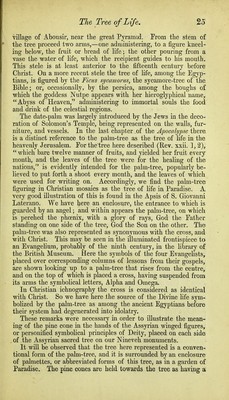
![village of Abousir, near the great Pyramid. From the stem of the tree proceed two arms,—one administering, to a figure kneel- ing below, the fruit or bread of life; the other pouring from a vase the water of life, which the recipient guides to his mouth. This stele is at least anterior to the fifteenth century before Christ. On a more recent stele the tree of life, among the Egyp- tians, is figured by the Ficus sycamorus, the sycamore-tree of the Bible; or, occasionally, by the persica, among the boughs of which the goddess Nutpe appears with her hieroglyphical name, Abyss of Heaven, administering to immortal souls the food and drink of the celestial regions. The date-palm was largely introduced by the Jews in the deco- ration of Solomon's Temple, being represented on the walls, fur- niture, and vessels. In the last chapter of the Apocalypse there is a distinct reference to the palm-tree as the tree of life in the heavenly Jerusalem. For the tree here described (Rev. xxii. ], 2), which bare twelve manner of fruits, and yielded her fruit every month, and the leaves of the tree were for the healing of the nations,55 is evidently intended for the palm-tree, popularly be- lieved to put forth a shoot every month, and the leaves of which were used for writing on. Accordingly, we find the palm-tree figuring in Christian mosaics as the tree of life in Paradise. A very good illustration of this is found in the Apsis of S. Giovanni Laterano. We have here an enclosure, the entrance to which is guarded by an angel; and within appears the palm-tree, on which is perched the phoenix, with a glory of rays, God the Father standing on one side of the tree, God the Son on the other. The palm-tree was also represented as synonymous with the cross, and with Christ. This may be seen in the illuminated frontispiece to an Evangelium, probably of the ninth century, in the library of the British Museum. Here the symbols of the four Evangelists, placed over corresponding columns of lessons from their gospels, are shown looking up to a palm-tree that rises- from the centre, and on the top of which is placed a cross, having suspended from its arms the symbolical letters, Alpha and Omega. In Christian ichnography the cross is considered as identical with Christ. So we have here .the source of the Divine life sym- bolized by the palm-tree as among the ancient Egyptians before their system had degenerated into idolatry. These remarks were necessary in order to illustrate the mean- ing of the pine cone in the hands of the Assyrian winged figures, or personified symbolical principles of Deity, placed on each side of the Assyrian sacred tree on our Nineveh monuments. It will be observed that the tree here represented is a conven- tional form of the palm-tree, and it is surrounded by an enclosure of palmettes, or abbreviated forms of this tree, as in a garden of Paradise. The pine cones are held towards the tree as having a](https://iiif.wellcomecollection.org/image/b21782945_0045.jp2/full/800%2C/0/default.jpg)