A clinical method of determining the vasomotor factor in blood-pressure / by Albert Abrams.
- Albert Abrams
- Date:
- 1904
Licence: Public Domain Mark
Credit: A clinical method of determining the vasomotor factor in blood-pressure / by Albert Abrams. Source: Wellcome Collection.
4/8 page 850
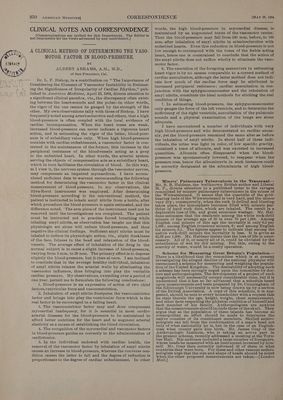
![CLINICAL NOTES AND CORRESPONDENCE [Communications are invited for this Department. The Editor is not responsible for the views advanced by any contributor. ] A CLINICAL METHOD OF DETERMINING THE VASO- MOTOR FACTOR IN BLOOD-PRESSURE. BY ALBERT ABRAMS, A.M., M.D., of San Francisco, Cal. Dr. L. F. Bishop, in a contribution on ‘‘ The Importance of Considering the Element of Vasomotor Instability in Estimat- ing the Significance of Irregularity of Cardiac Rhythm,” pub- lished in American Medicine, April 23, 1904, directs attention to a significant clinical paradox, viz., the discrepancy often exist- ing between the heart-sounds and the pulse—in other words, the vigor of the one cannot be gauged by the strength of the other. My own observations tally with those of Bishop. I have frequently noted among arteriosclerotics and others, that a high blood-pressure is often coupled with the local evidence of cardiac incompensation. When the heart tones are weak, increased blood-pressure can never indicate a vigorous heart action, and in estimating the vigor of the latter, blood-pres- sure is of subsidiary value only. When high blood-pressure coexists with cardiac enfeeblement, a vasomotor factor is con- cerned in the maintenance of the former, this increase in the peripheral resistance of the bloodvessels acting as a prop to the enfeebled heart. In other words, the arterial system serving the objects of compensation acts as a subsidiary heart, which in turn facilitates the circulation of blood. In this way, as I view it, the nervous system through the vasomotor nerves, may compensate an impaired myocardium. I have accum- ulated sufficient data to warrant recommending the following method for determining the vasomotor factor in the clinical measurement of blood-pressure. In my observations, the Riva-Rocci instrument was employed. After determining blood-pressure according to the conventional method, the patient is instructed to inhale amyl nitrite from a bottle, after which procedure the blood-pressure is again estimated, and the difference noted. “The arm piece of the instrument need not be removed until the investigations are completed. The patient must be instructed not to practise forced breathing while inhaling amyl nitrite, as observation has taught me that this physiologic act alone will reduce blood-pressure, and thus negative the clinical findings. Sufficient amyl nitrite must be inhaled to induce its physiologic action, viz., slight duskiness of the face, fulness in the head and relaxation of the blood- vessels. The average effect of inhalation of the drug in the normal subject is to cause a slight increase of blood-pressure, varying from 2mm. to20mm. The primary effect is to depress slightly the blood-pressure, but it rises at once. I am inclined to conclude that in the average healthy individual, inhalation of amyl nitrite relaxes the arterial walls by eliminating the vasomotor influence, thus bringing into play the veritable cardiac pressure. My observations, extending over a period of one year, permit me to formulate the following conclusions: ' 1. Blood-pressure is an expression of action of two chief factors, ventricular force and vasoconstriction. 2. Inhalation of amyl nitrite dissipates the vasoconstrictor factor and brings into play the ventricular force which is the real factor to be encouraged in a failing heart. 3. The vasoconstrictor factor may and does compensate myocardial inadequacy, for it is essential in most cardio- arterial diseases for the blood-pressure to be maintained to afford better nutrition for the heart and to augment arterial elasticity as a means of establishing the blood circulation, 4. The recognition of the myocardial and vasomotor factors in blood-pressure guides us correctly in the administration of cardiotonics. ' 5. In the individual endowed with cardiac health, the removal of the vasomotor factor by inhalation of amyl nitrite causes an increase in blood-pressure, whereas the converse con- dition causes the latter to fall and the degree of reduction is proportionate to the degree of cardiac enfeeblement. In other words, the high blood-pressure in myocardial disease, is maintained by an augmented tonus of the vasomotor center. mm. after inhalation of amyl nitrite in arteriosclerotics with enfeebled hearts. Even this reduction in blood-pressure is not low enough to correspond with the tones of the feeble acting heart, hence one is constrained to conclude that the action of the amyl] nitrite does not suffice wholly to eliminate the vaso- motor factor. 6. The execution of the foregoing maneuvers in estimating heart vigor is by no means comparable to a correct method of cardiac auscultation, although the latter method does not indi- cate how much of the cardiac force may be attributed to increased peripheral resistance; cardiac auscultation in con- junction with the sphygmomanometer and the inhalation of amy] nitrite, constitute the ideal methods for eliciting the real condition of things. 7. In estimating blood-pressure, the sphygmomanometer only gauges the force of the left ventricle, and to determine the sufficiency of the right ventricle, auscultation of the pulmonic sounds and a physical examination of the lungs are alone adequate. I have encountered a number of individuals with very high blood-pressure and who demonstrated no cardiac anom- aly, yet the blood-pressure remained the same after as before the inhalation of amyl nitrite. In about half of these indi- viduals, the urine was light in color, of low specific gravity, contained a trace of albumin, and was excreted in increased quantities. Albumin often disappeared when the blood- pressure was spontaneously lowered, to reappear when the pressure rose, hence the albuminuria in such instances could be correctly designated as the albuminuria of high blood- pressure. Miners’ Pulmonary Tuberculosis in the Transvaal.— Mr. R. B. Haldane, the wellknown British author and Liberal M. P., directs attention in a published letter to the ravages committed by miners’ pulmonary tuberculosis in the mines of the Witwatersrand. It seems that the quartzite of the gold- bearing beds of the Witwatersrand is very hard, and the mines very dry; consequently, when the rock is drilled and blasting takes place, the atmosphere becomes filled with minute par- ticles of hard rock dust, which are inhaled. The result is a deplorable loss of life, and great economic wastage. Mr. Hal- dane estimates that the deathrate among the white rock-drill miners of the average age of 35 is over 70 per1,000. Among English coal miners of this age the mortality is only 6.3 per 1,000; among English ironstone miners, 6; and among English tin miners, 8.1. The figures appear to indicate that among the native rock-drill miners the mortality is less. It is given as 42.03 per 1,000. Mr. Haldane insists that the loss of life is unne- eessary. All of it, or nearly all of it, could be obviated by the substitution of wet for dry mining. But this, owing to the Scheme for Measuring Great Britain’s Population.— There is a likelihood that the committee which is at present investigating the alleged decline of the national physique will recommend a scheme for measuring and weighing the popula- tion of the United Kingdom. The desirability of adopting such a scheme has been strongly urged upon the committee by doc- tors and anthropologists. The development of a project of such magnitude will necessarily occupy considerable time, but it is understood that it has so far advanced that a schedule based upon measurements and tests prepared by Dr. Cunningham of the Edinburgh University is now being drawn up by a section of the British Association. A copy of this schedule, it is sug- gested, should be sent to every householder with a request that he state therein the age, height, weight, chest measurement, and other facts respecting the physical condition of himself and each member of his family. Anthropologists are anxious that the measurements should include those of theskull. They argue that as the population of these islands has become so cosmopolitan an effort should be made to determine the native counties of its constituent members. Skilled anthro- pologists can tell from the conformation of a man’s head not only of what nationality he is, but in the case of an English- man what county gave him birth. Mr. James Gray of the Anthropologie Institute, who is taking an active part in the present scheme, recently addressed a meeting at the Toyn- bee Hall. His audience included a large-number of foreigners, whose heads he measured with an instrument invented by him- self. Mr. Gray then correctly informed 50 of them in what countries they were born. For these and other reasons anthro- pologists urge that the size and shape of heads should be noted Verkl other proposed measurements are taken.—[London Lait.](https://iiif.wellcomecollection.org/image/b33449351_0004.jp2/full/800%2C/0/default.jpg)