Scientific manpower : hearing before the Subcommittee on Science of the Committee on Science, Space, and Technology, U.S. House of Representatives, One Hundred Second Congress, first session, July 31, 1991.
- United States. Congress. House. Committee on Science, Space, and Technology. Subcommittee on Science
- Date:
- 1991
Licence: Public Domain Mark
Credit: Scientific manpower : hearing before the Subcommittee on Science of the Committee on Science, Space, and Technology, U.S. House of Representatives, One Hundred Second Congress, first session, July 31, 1991. Source: Wellcome Collection.
168/176 (page 164)
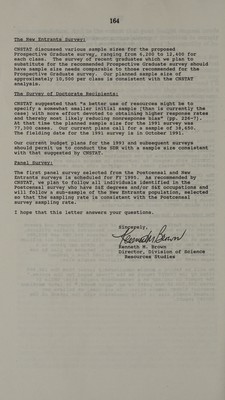
![The New Entrants Survey: CNSTAT discussed various sample sizes for the proposed Prospective Graduate survey, ranging from 6,200 to 12,400 for each class. The survey of recent graduates which we plan to substitute for the recommended Prospective Graduate survey should have sample size needs comparable to those recommended for the Prospective Graduate survey. Our planned sample size of approximately 10,500 per class is consistent with the CNSTAT analysis. The Survey of Doctorate Recipients: CNSTAT suggested that a better use of resources might be to specify a somewhat smaller initial sample [than is currently the case] with more effort devoted to obtaining higher response rates and thereby most likely reducing nonresponse bias (pp. 226-7). At that time the planned sample size for the 1991 survey was 77,300 cases. Our current plans call for a sample of 38,650. The fielding date for the 1991 survey is in October 1991. Our current budget plans for the 1993 and subsequent surveys should permit us to conduct the SDR with a sample size consistent with that suggested by CNSTAT. Panel Survey: The first panel survey selected from the Postcensal and New Entrants surveys is scheduled for FY 1995. As recommended by CNSTAT, we plan to follow all individuals identified in the Postcensal survey who have S&E degrees and/or S&E occupations and will follow a sub-sample of the New Entrants population, selected so that the sampling rate is consistent with the Postcensal survey sampling rate. I hope that this letter answers your questions. enneth M. Brown Director, Division of Science Resources Studies](https://iiif.wellcomecollection.org/image/b32218199_0168.jp2/full/800%2C/0/default.jpg)