Infant diet : a lecture / by A. Jacobi. Delivered May 8, 1873. Revised, enlarged, and adapted to popular use by Mary Putnam Jacobi, M.D.
- Abraham Jacobi
- Date:
- 1891
Licence: Public Domain Mark
Credit: Infant diet : a lecture / by A. Jacobi. Delivered May 8, 1873. Revised, enlarged, and adapted to popular use by Mary Putnam Jacobi, M.D. Source: Wellcome Collection.
Provider: This material has been provided by the Harvey Cushing/John Hay Whitney Medical Library at Yale University, through the Medical Heritage Library. The original may be consulted at the Harvey Cushing/John Hay Whitney Medical Library at Yale University.
94/132 page 88
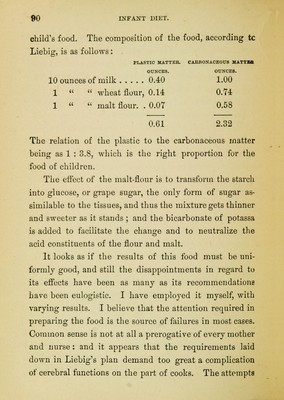
![that G. Bunge [Zeitsclirift fur Biologie, 1873) comes nearer to a satisfactory chemico-physiological explana- tion. We find that the craving for salt grows in propor- tion to the amount of potassa salts contained in the food. In the food of herbivores there is twioe or even four times as much potassa as in that of carnivores ; potatoes, with their large amount of potassium, combined with chlorine with phosphoric and citric (pomic) acids, necessi- tate the addition of large quantities of chloride of sodium. In the food of carnivores, however, who eat whole ani- mals, one equivalent of potassa is nearly balanced by one of soda and one of chlorine. Potassa salts and soda salts both exist in the blood, the former principally in the blood corpuscles, the latter entirely in the serum or watery part of the blood. There is chloride of ])otassium in both corpuscles and serum, but phosphate of potassa in the corpuscles alone. JS'ow if there should ever be in the blood more phosphate of potassa than can be taken up by the corpuscles, it will be immediately decomposed by the chloride of sodium in the serum—chloride of potassium and phosphate of soda are formed, and these are both rapidly eliminated by the kidneys, and pass away in the urine. By this means, chloride of sodium is carried away, and must be replaced: in other words, vegetable food requires the addition of a great deal of salt. The substitution of cow's milk for woman's milk](https://iiif.wellcomecollection.org/image/b21018911_0094.jp2/full/800%2C/0/default.jpg)