The oxygen treatment for wounds, ulcers, burns, scalds, lupus, and diseases of the nose, eye, and ear / by George Stoker.
- Stoker, George.
- Date:
- 1897
Licence: Public Domain Mark
Credit: The oxygen treatment for wounds, ulcers, burns, scalds, lupus, and diseases of the nose, eye, and ear / by George Stoker. Source: Wellcome Collection.
31/48 page 27
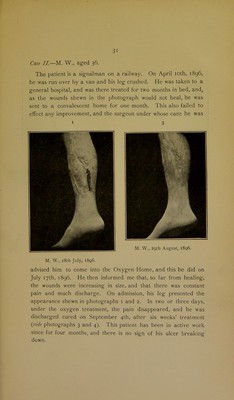
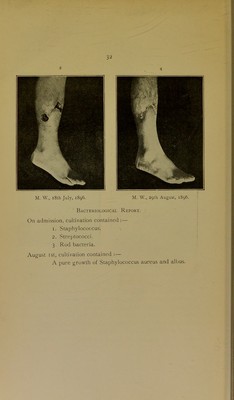
![5- That when this condition arises, if the strength of the oxygen solution , be increased,, then the favourable micro-organisms are increased and the unfavourable diminished. 6. That oxygen destroys the foul smells due to unfavourable micro organisms when they are exposed to its influence on the wounds. 7. That oxygen encourages the growth of favourable micro- organisms, that under its influence they grow larger, increase in number, and are more easily stained. 8. That when this condition pertains in reference to favourable micro-organisms, the wounds from which they are taken rapidly heal. We have also striven to find some simple bacteriological data for regulating the strength of the oxygen used, and beg to offer the following as a useful guide:—(a) Take a cultivation on agar, incubate for twenty-four hours, 37° C.; if tube smells foul increase the oxygen ; {b) If there is no foul smell reduce the oxygen, using half-a-foot of pure oxygen, and half-a-foot of purified air, this being what we call our “ standard strength.” This is, of course, a rough and ready way, but in accurate work much experience in examining microscopically the bacteria will be necessary. If anyone wants examinations made they can have them done at the Oxygen Home, 35 St. George’s Square, Pimlico, London, S.W. \_Now removed to 2 Fitzroy Square, IF.] We have gone some two steps further still. We have cultivated what we call favourable micro-organisms in pure air, pure oxygen, and varying strengths of oxygen, and find that the favourable micro-organisms grow best and stain easiest after cultivation in from 25 to 50 per cent, of pure oxygen mixed with purified air. It is found in practice that a solution as strong as 75 per cent, of pure oxygen, mixed with pure air, is too stimulating for any ordinary cases, and that with a weaker solution wounds heal better. There are thus two elements to be taken into consideration in regulating the quantity of oxygen to be used : — I. The condition and behaviour of the micro-organisms, favour- able and unfavourable, when cultivated on agar.](https://iiif.wellcomecollection.org/image/b28081250_0031.jp2/full/800%2C/0/default.jpg)
 No text description is available for this image
 No text description is available for this image
 No text description is available for this image