Licence: Public Domain Mark
Credit: A text book of physiology / by M. Foster. Source: Wellcome Collection.
Provider: This material has been provided by The University of Leeds Library. The original may be consulted at The University of Leeds Library.
37/714 page 29
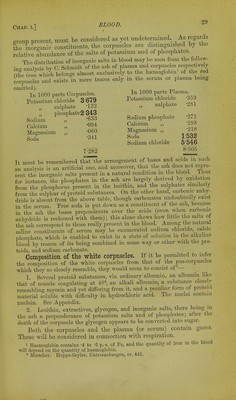
![Chap, i.] , *™0D. jP .roup present, must be considered as yet undetermined. As regards the inorganic constituents, the corpuscles are distinguished by the relative abundance of the salts of potassium and of phosphates. The distribution of inorganic salts in blood may be seen from the follow- in^ analysis by C Schmidt of the ash of plasma and corpuscles respectively (the iron which belongs almost exclusively to the hemoglobin of the red corpuscles and exists in mere traces only in the serum or plasma being omitted). In 1000 parts Corpuscles. In 1000 parts Hasma Potassium chloride 3679 Potassium chloride -359 „ sulphate -132 „ sulphate -281 ,, phosphate 2'343 _ _ n Sodium „ -633 Sodium phosphate -271 Calcium „ -094 Calcium „ 298 Magnesium „ '060 Magnesium „ 218 Sodt -341 Soda 1-532 b0da • Sodium chloride 5J546 T282 8-505 It must be remembered that the arrangement of bases and acids in such an analysis is an artificial one, and moreover, that_ the ash does not repre- sent the inorganic salts present in a natural condition in the blood. _ Ihus for instance, the phosphates in the ash are largely derived by oxidation from the phosphorus present in the lecithin, and the sulphates similarly from the sulphur of proteid substances. On the other hand, carbonic anhy- dride is absent from the above table, though carbonates undoubtedly exist in the serum. Free soda is put down as a constituent of the ash, because in the ash the bases preponderate over the acids (even when carbonic anhydride is reckoned with them); this alone shews how little the salts ot the ash correspond to those really present in the blood. Among the natural saline constituents of serum may be enumerated sodium chloride calcic phosphate, which is enabled to exist in a state of solution m the alkaline blood by reason of its being combined in some way or other with the pro- teids, and sodium carbonate. Composition of the white corpuscles. If it be permitted to infer the composition of the white corpuscles from that of the pus-corpuscles which they so closely resemble, they would seem to consist of2— I Several proteid substances, viz. ordinary albumin, an albumin like that of muscle coagulating at 48°, an alkali albumin, a substance closely resembling myosin and yet differing from it, and a peculiar form of proteid material soluble with difficulty in hydrochloric acid. The nuclei contain nuclein. See Appendix. 2. Lecithin, extractives, glycogen, and inorganic salts, there being in the ash a preponderance of potassium salts and of phosphates; after the death of the corpuscle the glycogen appears to be converted into sugar. Both the corpuscles and the plasma (or serum) contain gases. These will be considered in connection with respiration. » Haemoglobin contains -4 to -5 p. c. of Fe, and the quantity of iron in the blood will depend on tbe quantity of haemoglobin.](https://iiif.wellcomecollection.org/image/b21506917_0037.jp2/full/800%2C/0/default.jpg)