Licence: Public Domain Mark
Credit: A text book of physiology / by M. Foster. Source: Wellcome Collection.
Provider: This material has been provided by The University of Leeds Library. The original may be consulted at The University of Leeds Library.
50/714 page 42
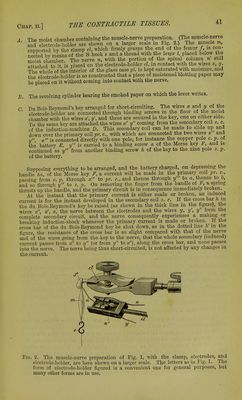
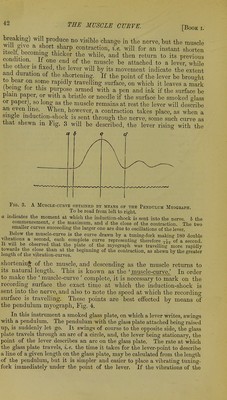
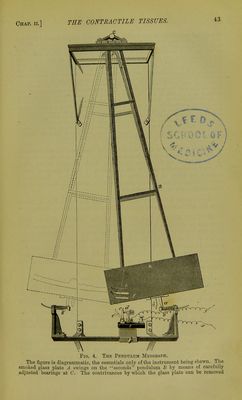
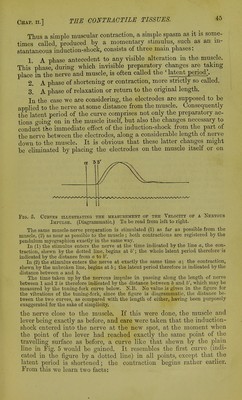
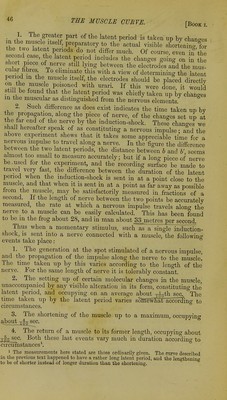
![[Book i. breaking) will produce no visible change in the nerve, but the muscle will give a short sharp contraction, i.e. will for an instant shorten itself becoming thicker the while, and then return to its previous condition. ^ If one end of the muscle be attached to a lever, while the other is fixed the lever will by its movement indicate the extent and duration of the shortening. If the point of the lever be brought to bear on some rapidly travelling surface, on which it leaves a mark [Demg tor this purpose armed with a pen and ink if the surface be plain paper, or with a bristle or needle if the surface be smoked glass or paper], so long as the muscle remains at rest the lever will describe an even lme. _ When, however, a contraction takes place, as when a single induction-shock is sent through the nerve, some such curve as that shewn in Fig. 3 will be described, the lever rising with the Fig. 3. A Muscle-cubve obtained by means of the Pendulum Mtogbaph. To be read from left to right. a indicates the moment at which the induction-shock is sent into the nerve b the commencement, c the maximum, and d the close of the contraction. The two smaller curves succeeding the larger one are due to oscillations of the lever. Below the muscle-curve is the curve drawn by a tuning-fork making 180 double vibrations a second, each complete curve representing therefore ^ of a second. It will be observed that the plate of the myograph was travelling more rapidly towards the close than at the beginning of the contraction, as shewn by the greater length of the vibration-curves. shortening of the muscle, and descending as the muscle returns to its natural length. This is known as the 'muscle-curve.' In order to make the * muscle-curve' complete, it is necessary to mark on the recording surface the exact time at which the induction-shock is sent into the nerve, and also to note the speed at which the recording surface is travelling. These points are best effected by means of the pendulum myograph, Fig. 4. In this instrument a smoked glass plate, on -which a lever writes, swings with a pendulum. The pendulum with the glass plate attached being raised up, is suddenly let go. It swings of course to the opposite side, the glass plate travels through an arc of a circle, and, the lever being stationaiy, the point of the lever describes an arc on the glass plate. The rate at which the glass plate travels, i. e. the time it takes for the lever-point to describe a line of a given length on the glass plate, may be calculated from the length of the pendulum, but it is simpler and easier to place a vibrating tuning- fork immediately under the point of the lever. If the vibrations of the](https://iiif.wellcomecollection.org/image/b21506917_0050.jp2/full/800%2C/0/default.jpg)