Statistics of fever and small-pox in Glasgow. Read to the Statistical Society of Glasgow, April 28, 1837 / [Robert Cowan].
- Robert Cowan
- Date:
- 1837
Licence: Public Domain Mark
Credit: Statistics of fever and small-pox in Glasgow. Read to the Statistical Society of Glasgow, April 28, 1837 / [Robert Cowan]. Source: Wellcome Collection.
15/40 page 11
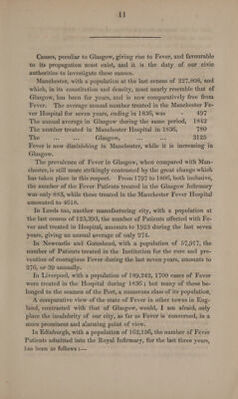
![1] Causes, peculiar to Glasgow, giving rise to Fever, and favourable to its propagation must exist, and it is the duty of our civic authorities to investigate these causes. Manchester, with a population at the last census of 227,808, and which, in its constitution and density, must nearly resemble that of Glasgow, has been for years, and is now comparatively free from Fever. The average annual number treated in the Manchester Fe- ver Hospital for seven years, ending in 1836, was - 497 The annual average in Glasgow during the same period, 1842 The number treated in Manchester Hospital in 1836, 780 The . “pes Glasgow, we no 3125 Fever is now diminishing in Manchester, while it is increasing in Glasgow. The prevalence of Fever in Glasgow, when compared with Man- chester, is still more strikingly contrasted by the great change which has taken place in this respect. From 1797 to 1806, both inclusive, the number of the Fever Patients treated in the Glasgow Infirmary was only 883, while those treated in the Manchester Fever Hospital amounted to 4618. In Leeds too, another manufacturing city, with a population at the last census of 123,393, the number of Patients affected with Fe- ver and treated in Hospital, amounts to 1923 during the last seven years, giving an annual average of only 274. In Newcastle and Gateshead, with a population of 57,917, the number of Patients treated in the Institution for the cure and pre- vention of contagious Fever during the last seven years, amounts to 276, or 39 annually. In Liverpool, with a population of 189,242, 1700 cases of Fever were treated in the Hospital during 1836; but many of these be- longed to the seamen of the Port, a numerous class of its population, A comparative view of the state of Fever in other towns in Eng- land, contrasted with that of Glasgow, would, I am afraid, only place the insalubrity of our city, as far as Fever is concerned, in a more prominent and alarming point of view. In Edinburgh, with a population of 162,156, the number of Fever Patients admitted into the Royal Infirmary, for the last three years, has been as follows :—](https://iiif.wellcomecollection.org/image/b33285548_0015.jp2/full/800%2C/0/default.jpg)