Report of the Royal Commission on the Poor Laws and Relief of Distress. : Appendix Volume XIX A. Report by the Rev. J.C. Pringle on the effects of employment or assistance given to the "unemployed" since 1886 as a means of relieving distress outside the Poor Law in Scotland.
- Royal Commission on the Poor Laws and Relief of Distress 1905-09
- Date:
- 1910
Licence: In copyright
Credit: Report of the Royal Commission on the Poor Laws and Relief of Distress. : Appendix Volume XIX A. Report by the Rev. J.C. Pringle on the effects of employment or assistance given to the "unemployed" since 1886 as a means of relieving distress outside the Poor Law in Scotland. Source: Wellcome Collection.
Provider: This material has been provided by London School of Hygiene & Tropical Medicine Library & Archives Service. The original may be consulted at London School of Hygiene & Tropical Medicine Library & Archives Service.
201/244 page 183
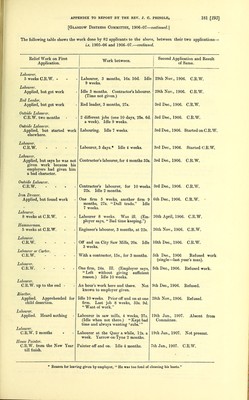
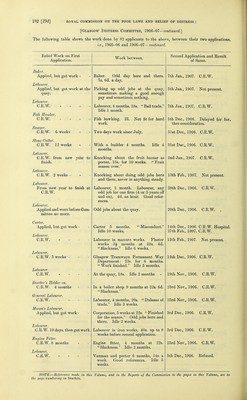
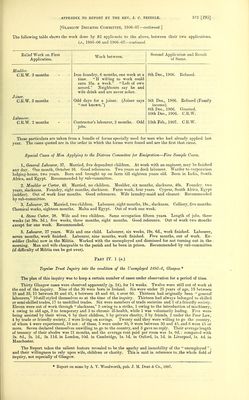
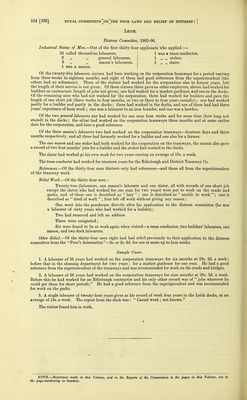
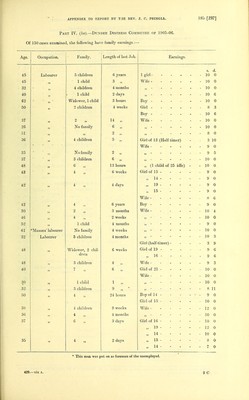
![[Glasgow Distress Committee, 1906-07—continued.] The following table shows the M^ork done by .82 applicants to the above, between their two applications, i.e., 1905-06 and 1906-07—eontinved. Belief Work on First Application. Work between. Second Applicfition and Result of Same. Moulder. C.R.W. 3 months Joiner. C.R.W. 3 months Labourer. C.R.W. 2 months Iron foundry, 6 months, one week at a time. If willing to work could earn 35s. a week. Left of own accord. Neighbours say he and wife drink and are never .sober. Odd days for a joiner. (Joiner says not known.) Contractor's labourer, 2 months. Odd jobs. 8th Dec, 1906. Refused. 5th Dec, 1906. Refused (Family income). 8th Dec, 1906. Granted. 10th Dec, 1906. C.R.W. 15th Feb., 1907. C.R.W. These particulars are taken from a bundle of forms specially used for men who had already applied last year. The cases quoted are in the order in which the forms were found and are the first that came. Special Cases of Men Applying to the Distress Committee for Emigration—Five Sample Cases. 1.. General Labourer, 37. Married, five dependent children. At work with an engineer, may be finished any day. One month, October 16. Good references. Two years as dock labourer. Warder to corporation lodging-house, two years. Born and brought up on farm till eighteen years old. Been in India, South Africa, and Egypt. Recommended by sub-committee. 2. Moulder or Carter, 40. Married, no children. Moulder, six months, slackness, 40s. Foundry, two years, slackness. Foundry, eight months, slackness. Farm work, four years. Cyprus, South Africa, Egypt (soldier). Out of work four months. Good references. Wife laundry-maid and cleaner. Recommended by sub-committee. 3. Labourer, 28. Married, two children. Labourer, eight months, 18s., slackness. Colliery, five months. Chemical works, eighteen months. Malta and Egypt. Out of work one week. 4. Stone Cutter, 28. Wife and two children. Same occupation fifteen years. Length of jobs, three weeks (at 38s. 3d.), five weeks, three months, eight months. Good reference. Out of work two rfionths except for one week. Recommended. 5. Labourer, 27 years. Wife and one child. Labourer, six weeks, 19s. 6d., work finished. Labourer, seven months, work finished. Labourer, nine months, work finished. Five months, out of work. Ex- soldier (India) now in the Militia. Worked with the unemployed and dismissed for not turning out in the morning. Man and wife chargeable to the parish and he been in prison. Recommended by sub-committee (if difficulty of Militia can be got over). Part IV. 1 (a.) Toynhee Trust Inquiry into the condition of the Unemployed 1895-6, Glasgow.* The plan of this inquiry was to keep a certain number of cases under observation for a period of time. Thirty Glasgow cases were observed apparently (p. 24), for 14 weeks. Twelve were still out of work at the end of the inquiry. Nine of the 30 were born in Ireland. Six were under 25 years of age, 15 between 25 and 35, 11 between 35 and 45, 4 between 45 and 60, 4 over 60. Thirteen had originally been general labourers, 10 still styled themselves so at the time of the inquiry. Thirteen had always belonged to skilled or semi-skilled trades, 17 to unskilled trades. Six were members of trade societies and 1 of a friendly society. Eleven were out of work through slackness, 5 owing to a strike, 1 owing to the introduction of machinery,, 4 owing to old age, 3 to temporary and 3 to chronic ill-health, while 1 was voluntarily loafing. Five were being assisted by their wives, 6 by their children, 5 by private charity, 3 by friends, 2 under the Poor Law, 4 by trade or friendly society, 2 were living on savings. Twenty said they were willing to go the country, of whom 4 were experienced, 16 not: of these, 5 were under 30, 9 were between 30 and 45, and 6 were 45 or more. Seven declared themselves unwilling to go to the country, and 3 gave no reply. Their average length of tenancy of their abodes was 21 months, and the average rent paid per room was Is. 6d. : compared with 2s. 8d., 2s. Id., 2s. lld. in London, lOd. in Cambridge, Is. Id. in Oxford, Is. Id. in Liverpool, Is. 4d. in Manchester. The Report takes the salient feature revealed to be the apathy and immobility of the unemployed ; and their willingness to rely upon wife, children or charity. This is said in reference to , the whole field of inquiry, not especially of Glasgow. * Report on same by A. V. Woodworth, pub. J. M. Dent & Co., 1897.](https://iiif.wellcomecollection.org/image/b2439998x_0201.jp2/full/800%2C/0/default.jpg)