The elements of botany : structural and physiological : with a sketch of the artificial modes of classification, and a glossary of technical terms / by John Lindley.
- John Lindley
- Date:
- 1861
Licence: Public Domain Mark
Credit: The elements of botany : structural and physiological : with a sketch of the artificial modes of classification, and a glossary of technical terms / by John Lindley. Source: Wellcome Collection.
Provider: This material has been provided by The University of Leeds Library. The original may be consulted at The University of Leeds Library.
186/280 (page 26)
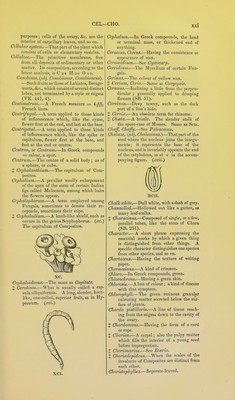
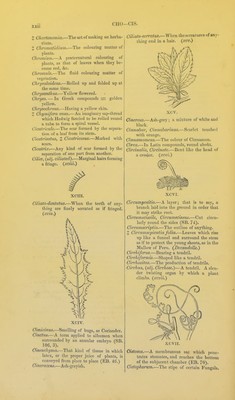
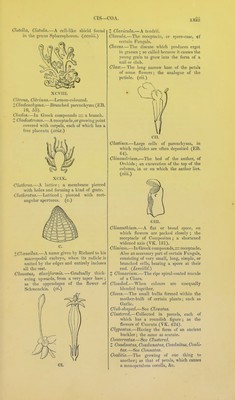
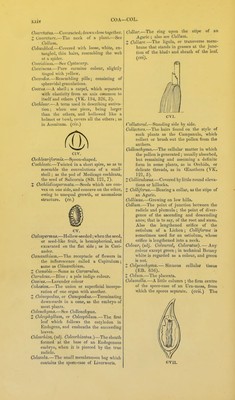
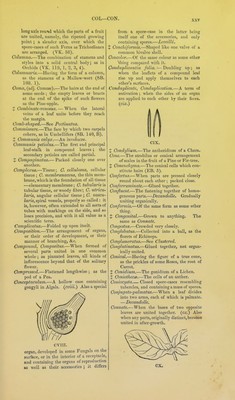
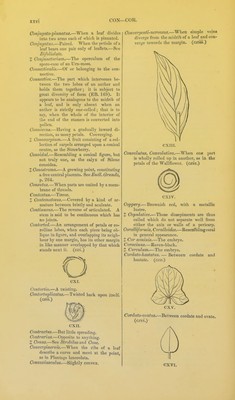
![Conjugato-pinnatus.—Wlicn a leaf divides into two amis each of which is pinnated. Conjufjatm.—Paired. When the petiole of a leaf bears one pair only of leaflets.—See Bifoliolate. X Conjunctonum.—The operculum of the spore-case of an Urn-moss. Connectivalis.—Of or belonging to the con- nective. Con/nectivc.—The part ■which intervenes be- tween the two lobes of an anther and holds them together; it is subject to great diversity of form (EB. 16.9). It appears to be analogous to tlie midrib of a leaf, and is only absent when an anther is strictly one-celled; that is to say, W'hen the whole of the interior of the end of the stamen is converted into pollen. Connivcns.—Having a gradually inward di- rection, as many petals. Converging. J Conocarpium.—A fruit consisting of a col- lection of caipels arranged upon a conical centre, as the Strawberry. Conoidal.—Resembling a conical figure, but not truly one, as the calyx of Silene conoidea. J Conostroma.—A growing point, constituting a free central placenta. See Endl. GrUTidz, p. 264. Consuti^s.—When parts are united by a mem- brane of threads. Contextus.—Tissue. % Contematosus.—Covered by a kind of ar- mature between bristly and aculeate. Continuous.—The reverse of articulated. A stem is said to be continuous which has no joints. Contorted.—An arrangement of petals or co- roUine lobes, when each piece being ob- lique in figure, and overlapping its neigh- bour by one margin, has its other margin in like manner overlapped by that which stands next it. {cxi.) Convei'genti-nervosus.—When simple veins diverge from the midrib of a leaf and con- verge towards the margin, (cxiii.) CXI. Contortio.—A twisting. Contortuplicatus.—Twisted back upon itself. {cocii.) CXII. Contractus.—But little spreading. Contrarius.—Opposite to anything. X Conus.—See Strobilus a.T]d Cone. Converrjinervis.—When the ribs of a leaf descrihe a curve and meet at the point, as in Plantago lanceolata. Comexiusculus.—Slightly convex. CXIII. Convolutus, Convolutiva.—AVhen one part is wholly rolled up in another, as in the petals of the Wallflower, {cxiv.) CXIV. Coppery.—Browish red, with a metallic lustre. X Copulative.—Those dissepiments are thus called which do not separate well from either the axis or walls of a pericarp. Corallifoi'mis, Coralloides.—Resenihlingcoral in general appearance. X Cor seminis.—The embryo. Coracinus.—Raven-black. X Corculum.—The embryo. Cordato-hastatus. — Between cordate and hastate, (c.tv.) cxv. Cordato-oratus.—Between cordate and ovate. {cxvi.) CXVI.](https://iiif.wellcomecollection.org/image/b21518117_0186.jp2/full/800%2C/0/default.jpg)