The elements of botany : structural and physiological : with a sketch of the artificial modes of classification, and a glossary of technical terms / by John Lindley.
- John Lindley
- Date:
- 1861
Licence: Public Domain Mark
Credit: The elements of botany : structural and physiological : with a sketch of the artificial modes of classification, and a glossary of technical terms / by John Lindley. Source: Wellcome Collection.
Provider: This material has been provided by The University of Leeds Library. The original may be consulted at The University of Leeds Library.
195/280 (page 35)
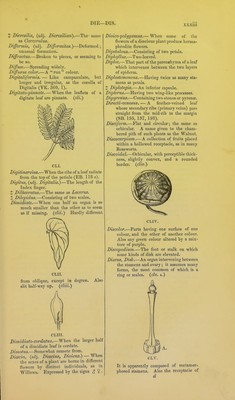
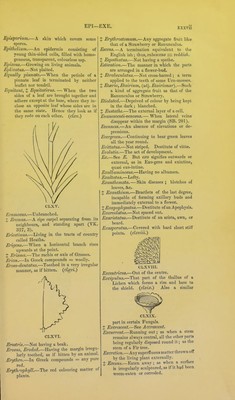
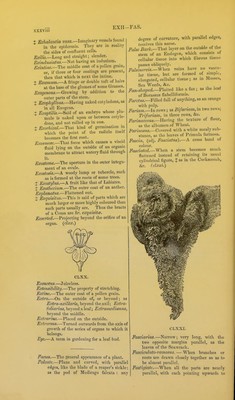
![ECH-END. XXXV EcJiinatus—Furnished with numcrons rigid hairs, or straight prickles ; as tho fiuit of Castanea vesca. (ctvii.) CLVU. + Ehilatus.—Not having a pciforation; only applied to pollen gi-ains. Elaio.—In Greek compounds = olive colour, a mixture of green and brown. J Elaterium.—See Regma. A tricoccous fruit. Elaters.—Spiral elastic threads, generated in tubes in certain Liverworts and Scale- mosses, and supposed to assist in the dis- persion of spores (VK. 38, 4). Elutus.—This is said of plants which are taller than their other organs would have led one to expect. J Eleutheranthenis.—Having the anthers dis- tinct from each other. Eleutheros.—In Greek compounds = dis- tinct, separate. Ellipsoidal.—A solid with an elliptical figure Ellipticus.—A flat body, which is oval and acute at each end (SB. 145). Elongatio.—The act of increasing in length Elongatus.—Lengthened or sti'etched out, as it were. + Ehitnculus.—A floret. Emarcidus.—Flaccid, welted. Eiiiarginatura, (adj. Emarginate).—Having a notch at the end, as if a piece had been taken out. {clviii.) CLViri. Embolus.—A plug ; a process which projects downwards from tiie uj)per part of the cavity of the ovary in Armeria, .md closes up the foramen of the ovule. Embracing.—Clasping with the base. See Am^lectam. Embr)/o, Embryonalis). ~ The rudi- mentary plant, engendered within a seed by the action of pollen, {clix.) CLX, CLIX Embryo-buds.—Spheroidal solid bodies, of unknown origin, resembling woody nodules, formed in the bark of trees, and capable of extending into branches under favourable circumstances. X Embryo, fixed.—A leaf-bud. iEinh-yoteg-ium,E/nbryonitcga, Emlry tega. —A little papilla, often sepa- rating as a lid, which covers over the radicle of some kinds of embryo, (clx.) It is the hardened apex of the nu- cleus. t Empennatus.—Pinnated. X Emphysematosus.—Bladdery, resembling a bladder. Endeca.—In Greek compounds = eleven. Endocaip.—The lining of a carpel; the inner surface of a fruit, representing at that time the upper surface of a carpellury leaf. The stone of a cherry is its endocarp. i Endochroa.—A supposed interior layei- of the cuticle. Endochrome.—The colouring matter of plants In Algals the colouring matter found in the cells ; sometimes the entire contents of their cells. Endogenous.—Growing by the addition of new wood to the centre of the stem. Endogonium.—The contents of the nucule of a Chara. Endopklceum.—The liber of bark ; the inner layer, containing woody tissue, lying next the wood. X Endophragma.—A partition in the interior of tlie frond of some Seaweeds. X Endophyllous.—Formed from within a theathing leaf; as the young leaves of Kndogens. Endopleura.—The innermost skin of a seed- coat. X Endoptile.—^'sa'u] of an emhiyo whose jlu- mulc is rolled up by the cotyledon, as in Endogens. X Endophyte.—The woody bodj', or timber of an Exogen, inrlitding the pith. d 2](https://iiif.wellcomecollection.org/image/b21518117_0195.jp2/full/800%2C/0/default.jpg)