The elements of botany : structural and physiological : with a sketch of the artificial modes of classification, and a glossary of technical terms / by John Lindley.
- John Lindley
- Date:
- 1861
Licence: Public Domain Mark
Credit: The elements of botany : structural and physiological : with a sketch of the artificial modes of classification, and a glossary of technical terms / by John Lindley. Source: Wellcome Collection.
Provider: This material has been provided by The University of Leeds Library. The original may be consulted at The University of Leeds Library.
206/280 (page 46)
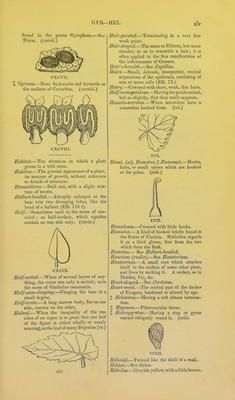
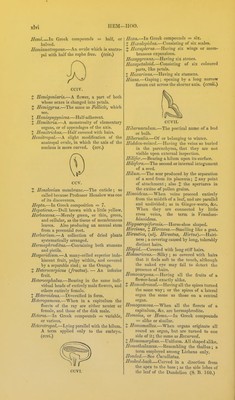
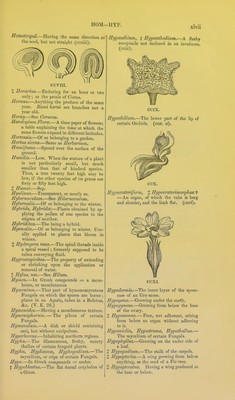
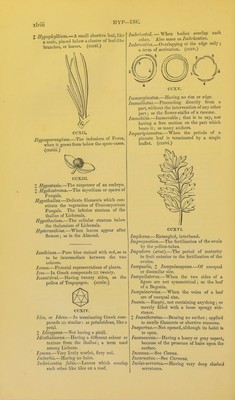
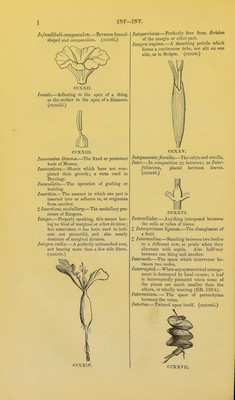
![HEM—IIOO. Hemi. In Greek compounds = half, or halved. Hemianatropous.—An ovule which is anatro- pal with half the raphe free, (ccw.) CCIV. X Hemigoniaris.—A flower, a part of both whose sexes is changed into petals. X Hemigyrus.—The same as Follicle, which see. X nemisyngynicus.—Half-adherent. X Uemitcria.—A monstrosity of elementary organs, or of appendages of the axis. X Hemitrichus.—Half covered witli hairs. Hemitropal.—A sliglit modification of the anatropal ovule, in which the axis of the nucleus is more curved, (cct.) ccv. X Henslovian membrane.—The cuticle ; so called because Professor Henslow was one of its discoverers. Hepta.—In Greek composition = 7. Hexmticm.—Dull brown with a little yellow. Herhojceous.—Merely greeu, or thin, green, and cellular, as the tissue of membranous leaves. Also producing an annual stem from a perennial root. Herbarium.—A collection of dried plants systematically arranged. Hei'maphroditus.—Containing both stamens and ])istils. Hespendium.—A many-celled superior inde- hiscent fruit, pulpy within, and covered by a separable rind; as the Orange. X Heterocarpicus (Jmctus). — An inferior fruit. Heteroceplialus.—Bearing in the same indi- vidual heads of entirely male flowers, and others entirely female. + Heteroideus.—Diversified in form. Htterogamous.—When in a capitulum the florets of the ray are either neuter or female, and those of the disk male. Heteros.—In Greek compounds = variable, or various. Ilcterotropal.—Lying parallel with the hilum. A term applied only to the embryo. {ccvi.) CCVI. Uexa.—In Greek compounds = six. X Ilcxalepidm.—Consisting of six scales. X Ilcvapieriis.—Having six wings or mem- branous expansions. Hexapyrenus.—Having six stones. Hexapetaloid.—Consisting of six coloured parts, like petals. X Hexarinus.—Having six stamens. Hians.—Gaping; opening by a long narrow fissure cut across the shorter axis, (ccvii.) CCVII. Hibemaculmi.—The poetical name of a bud or bulb. Jliiertialis.—Of or belonging to winter. lliddcn^veined.—Having the veins so buried in the parenchyma, that they are not visible upon external inspection. Hiliftr.—Bearing a hilum upon its surface. Hilofera.—The second or internal integument of a seed. Hilum.—Tlie scar produced by the separation of a seed from its placenta; J any point of attachment; also X the apertures in the cxtine of pollen grains. Hinoideus.—When veins ])rocccd entirely from the midrib of a leaf, and are pai-allcl and undivided; as in Ginger-worts, &c. When they are connected by little cross veins, the term is Venuloso- hinoideus. Hippocrepiformis.—Horse-shoe shaped. Hircinus, X Hircosus.—Smelling like a goat. Hirsuties, (adj. Hirsutus, Hirtus).—Hairi- ness ; a covering caused by long, tolerably distinct hairs. Hispid.—Covered with long stiff hairs. Holosenceus.—Silky ; so covered with hairs that it feels soft to the touch, although the naked eye may fail to detect the presence of hairs. Homocarpous.—Having all the fruits of a flower-head exactly alike. X Homodromal.—Having all the spires turned the same way; or the spires of a lateral organ the same as those on a central organ. Homogamous.—When all tlie florets of a capitulum, &c. are hermaphrodite. Homoios, or Homo.—In Greek compounds = alike or siniihar. X Homomallus.—When organs originate all round an organ, but are turned to one side of it; the same as Recurved. X Homomorplius.—Uniform. All shaped alike. Homothalamus.—Resembling the thallus; a term employed among Lichens only. Hooded,—See Cucullatus. Hoohcd-back—Curved in a direction from the apex to the base ; as the side lobes of the leaf of the Dandelion (S. B. 160.)](https://iiif.wellcomecollection.org/image/b21518117_0206.jp2/full/800%2C/0/default.jpg)