The elements of botany : structural and physiological : with a sketch of the artificial modes of classification, and a glossary of technical terms / by John Lindley.
- John Lindley
- Date:
- 1861
Licence: Public Domain Mark
Credit: The elements of botany : structural and physiological : with a sketch of the artificial modes of classification, and a glossary of technical terms / by John Lindley. Source: Wellcome Collection.
Provider: This material has been provided by The University of Leeds Library. The original may be consulted at The University of Leeds Library.
225/280 (page 65)
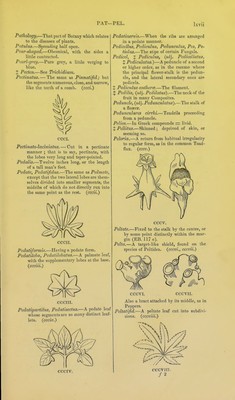
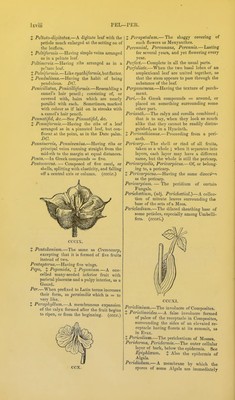
![OVA—PAP. Jxv lower end, so as to resemble the longi- tudinal section of an egg. {ccxc.) Oval.—See ElUpticus. Ovary.—That part of the pistil which contains tlie ovules. + Ovella.—Young carpels. Ovenchyma.—Oval cellular tissue (EB. 6). Ovoidal.—A solid with an ovate figure, or resembling an egg. DC. (ccxci.) CCXCI. Ovtdc, t Ovum.—The young seed. Oimle-tube.—A thread-like extension of the apex of the nucleus, or of the sac of the amnios, rising up beyond the foramen. Pacliystichus.—Thick-sided; applied to cells only. Pagma.—The surface of anything. Painted.—When colours are disposed in streaks of unequal intensity. Paired.—See Conjugatus. t Palaceous.— Having a foot-stalk which adheres to the margin of a leaf, as is usually the case. Palaris.—A root which is perfectly continuous with the stem. Palari-ramosus.—A root which is palar, and produces numerous branches from its sides, {ccxcii.) CCXCII. Palate.—The prominent lower lip of a ringent corolla (SB. 183). Palece (adj. Paleaceous). — Membranous scales resembling chaff. The inner scales of the flower in Grasses (SB. 235, 2). Palfaformis.—Resembling a palea or chaff, as Jlamenta, which see. P(.deace<ms, t Paleoliferus. — Covered with ])aleae, as the receptacle of many Com- posites. J Palcolce.— The hypogynous scales of Grasses. Palm (adj. Pal marls).—Tiwee inches, or the breadth of the four fingers of the hand. Palm-reined. — Having tlie i)iincipal vein radiating from a common point. Palmate.—Having five lobes, the mid-ribs of which meet in a common point, so that the whole bears some resemblance to a h\iman hand, as the leaf of the Maple. (SB. 23). Pahnatifid. — Cut half-way down in a pal- mate manner (SB. 23). Palmatihhed.—Cut into shallow divisions in a palmate manner. Palmatinervius, Palnmiervis.—See Palm- veined. Palmatiparted, Palmatiseded.—Cut nearly to the base in a palmate manner; a near approach to digitate. Palmiformis, Pabnatifoi'mis.—When nume- rous ribs of a leaf are arranged as in tlie palmate form, radiating from the top ot the peiiolr. (ccxciii.) CCXCIII. Pal/udosuS) Palustris.—Growing in marshy places. Panduratus, Panduriformis.—See Fiddle- shaped. Panicle.—A branched raceme (EB. 140, \). Pannosus.—Having the texture of coarse cloth. X Pantacliohryus —Growing in a circular manner. Papery.—See Chartaceus. Papilionaceous.—Having such a corolla as tiiat of the Pea. (ccxciv.) CCXCIV. PapillcB.—Soft, oblong, snpeificial glands. Also the acicula; of certain Fungals. Papillosus, Papilliferus.—Covered with mi- nute soft tubercles or excrescences. Pappus.—The calyx of Composites, where /](https://iiif.wellcomecollection.org/image/b21518117_0225.jp2/full/800%2C/0/default.jpg)