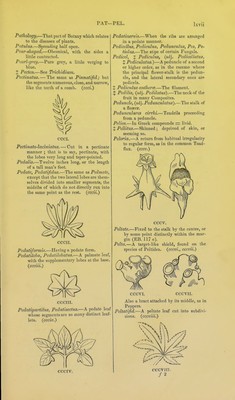
The elements of botany : structural and physiological : with a sketch of the artificial modes of classification, and a glossary of technical terms / by John Lindley.
- John Lindley
- Date:
- 1861
Licence: Public Domain Mark
Credit: The elements of botany : structural and physiological : with a sketch of the artificial modes of classification, and a glossary of technical terms / by John Lindley. Source: Wellcome Collection.
Provider: This material has been provided by The University of Leeds Library. The original may be consulted at The University of Leeds Library.
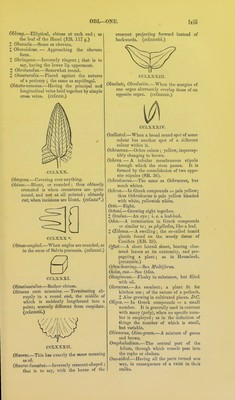
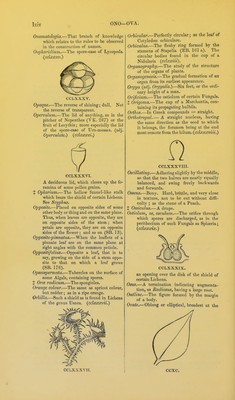
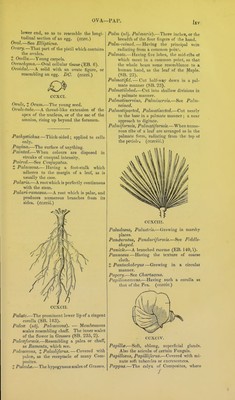
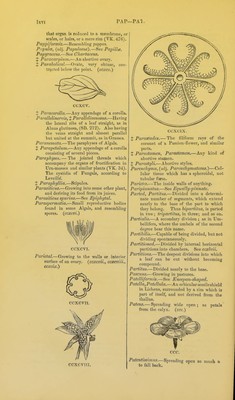
226/280 (page 66)
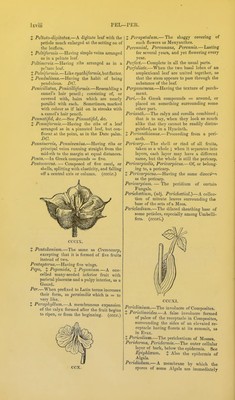
![that organ is reduced to a membrane, or scales, or hairs, or a mere rim (VK. 476). Pappiformis.—Resembling pappus. Pi(pulce, (adj. Papulosus).—Sec Papilla. Papyracevs.—See CJiartaceus. J Parucarpium.—An abortive ovary. I Parabolical.—(3vate, very obtuse, con- tracted below the point, {ccxcv.) ccxcv. J Paracorolla.—Any appendage of a corolla. Pirallelinervis, + Parallelivenosus.—Having the lateral ribs of a leaf straight, as in Alnus glutinosa, (SB. 212). Also having the veins straight and almost parallel but united at the summit, as in Grasses. Paranemata.—The paraphyses of Algals. + Parapetalum.—Any a])pendage of a corolla consisting of several pieces. Paraphyses. — The jointed threads which accompany the organs of fructification in Urn-mosses and similar plants (VK. 34). The cystidia of Fungals, according to LeveilM. X Paraphyllia.—Stipules. Parasiticus.—Growing into some other plant, and deriving its food from its juices. Parasiticus spurius.—See Epiphytal. Paraspermatia.—Small reproductive bodies found in some Algals, and resembling spores, (ccxcvi.) CCXCVI. Parietal.—Growing to the walls or interior surface of an ovary, {ccxcvii., CCXCviii,, ccxcix.) CCXCVII. CCXCVIII. CCXCIX. Parastades.— The filiform rays of the coronet of a Passion-flower, and similar parts. Parastamen, Parastemon.—Any kind of abortive stamen. Parastyli.—Abortive styles. Parenchyma, (adj. Parenchymatosiis.)—Cel- lular tissue which has a spheroidal, not tubular farm. Panetes.—The inside walls of anything. Paripinnatus.—See Equally-pinnate. Parted, Partitus.—Divided into a determi- nate number of segments, which extend nearly to the base of the part to which they belong. Thus hipartilu^, is parted in two ; tripaHitus, in three; and so on. Partialis.—A secondary division ; as in Um- bellifers, where the umbels of the second degree bear this name. Partibilis.—Capable of being divided, but not dividing spontaneously. Partitioned.—Divided by internal honzontal partitions into chambers. See ccxltni. Partitions.—The deepest divisions into which a leaf can be cut without becoming compound. Partitus.—Divided nearly to the base. Pascuv^.—Growing in pastures. Patelliformis.—See Kneepan-shaped. Patella, Patellula.—An orbicular sessile shield in Lichens, surrounded by a rim which is part of itself, and not derived from the thallus. Patens.— Spreading wide open; as petals from the calyx, (ccc.) CCC. Patentissimm.—SYircading open so much a to fall back.](https://iiif.wellcomecollection.org/image/b21518117_0226.jp2/full/800%2C/0/default.jpg)