Presidential address at the Epidemiological Society : delivered on November 5th, 1879 / by Sir Joseph Fayrer.
- Fayrer, Sir Joseph, 1824-1907.
- Date:
- [1879]
Licence: Public Domain Mark
Credit: Presidential address at the Epidemiological Society : delivered on November 5th, 1879 / by Sir Joseph Fayrer. Source: Wellcome Collection.
Provider: This material has been provided by The Royal College of Surgeons of England. The original may be consulted at The Royal College of Surgeons of England.
4/16 page 4
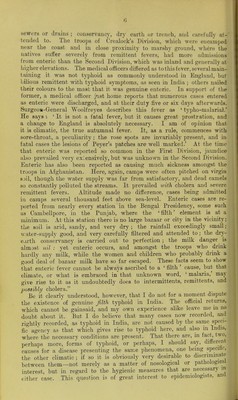
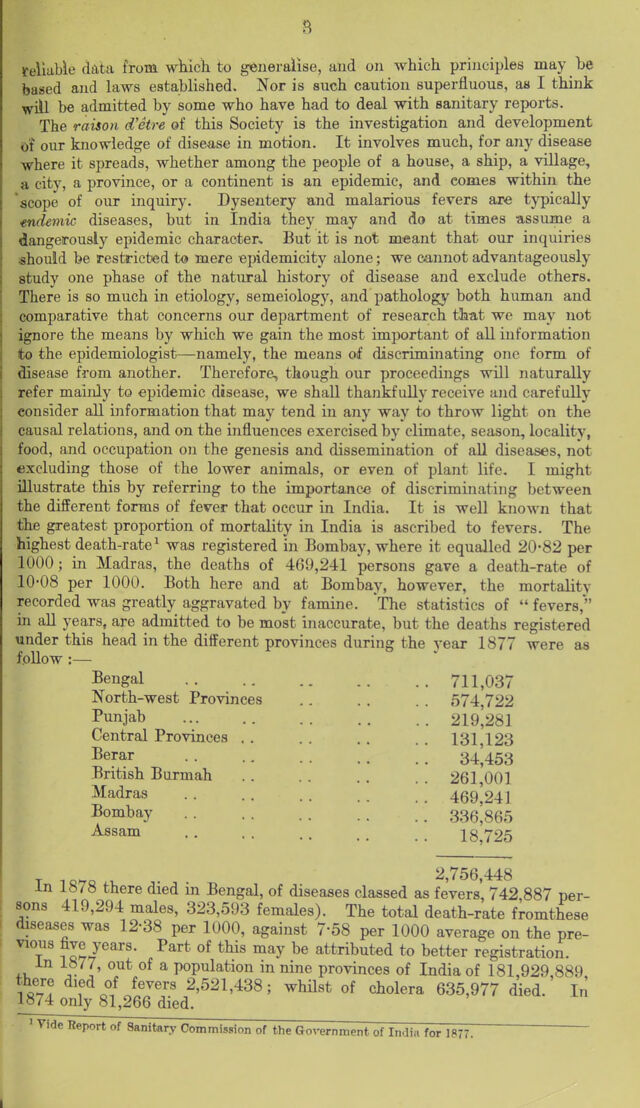
![In his report for 1878 the sanitary commissioner, Dr. J.ittlo, of tie Hyderabad assigned districts, shows that there was exceptional mortality durinf,' that year. In a population of about 2,18(5,088 the death-rate was 81^ per lOOO ii.], 1878, against »2-l per 1000 in the previous year. The total deaths in the year were 178,404,, and the causes were as follow, fever being the most prominent:— ' Death causes. Jo^a) Beatlis ,„ , deaths. per lOOO: Cholera 34,30f3 15-6 Small-pox Fevers Bowel complaints Injuries All other causes 5,850 2-7 85,260 38-9 27,577 12-6 1,147 -5 24,264 ... 11-1 All causes 178,4a# 81-4 This great mortality is probably partly attributable to the indirect in- fluence of the famine, which deprived the province of much of its most wholesome food by causing exportation of grain to the famine districts. The population to a great extent thus subsisted on an inferior, or deterior- ated, kind of grain. There wBre other local climatic causes, but to- these I need not allude. I refer to the subject as an evidence of the great mor- tality of fevers as compared with other diseases. There is no doubt that, under the heading Fever, many deaths from other causes are recorded, and we may probably refer a large proportion of them to diseases of an inflammatory character affecting the thoraic or other viscera, or to compIicatioTia involving inflammatory action elsewhere. In a vast country like India, where the population is so extensive, and the means of registration of necessity limited, often not under metficaS supervision at aU, it is not to be expected that greater accuracy can be ensured ; but, were it possible to discriminate among the various forms of disease returned as causing the' mortality by fever, we should have a ▼ery different result from the present. One can hardly refer to this subject without expressing admiration at the great progress that has been made- of late years in registration under the direction of the sanitary authorities of India, and confidence that it wiU continue to. improve, and render the statistics more valuable even than they are now. Ot course,, where the registration of death is not subject to medical definition, dis- crimination between the various forms of fever or other death-causes could! hardly be expected ; and therefore the example I have just given is hardly so good an illustration of what I refer to as typhoid, for which we have accurate medical statistics of our European troops in India. It is within my recollection that attention was first called to the existence of this form of fever in India, and yet there can be, I suppose, no doubt that it has always been there. It soon became generaUy recognised as a new dis- covery in India, and people wondered how it had escaped observation hitherto, whilst some perchance regarded it as a new disease. But it was just this power of discriminating observation that is so rare and so valu- able that had been wanting ; it was this that, exercised by Budd, Jenner» Murchison, and others after them, established a new era m the nosology of-fevers in England ; and it was this, that, a little later, m India, discn- minat<^d between certain forms of remittent and enteric (i.e., between I](https://iiif.wellcomecollection.org/image/b22305415_0006.jp2/full/800%2C/0/default.jpg)