Report to Her Majesty's Principal Secretary of State for the Home Department from the Poor Law Commissioners, on an inquiry into the sanitary condition of the labouring population of Great Britain ; with appendices. Presented to both Houses of Parliament, by command of Her Majesty, July, 1842.
- Board of guardians
- Date:
- 1842
Licence: Public Domain Mark
Credit: Report to Her Majesty's Principal Secretary of State for the Home Department from the Poor Law Commissioners, on an inquiry into the sanitary condition of the labouring population of Great Britain ; with appendices. Presented to both Houses of Parliament, by command of Her Majesty, July, 1842. Source: Wellcome Collection.
Provider: This material has been provided by London School of Hygiene & Tropical Medicine Library & Archives Service. The original may be consulted at London School of Hygiene & Tropical Medicine Library & Archives Service.
53/544 page 17
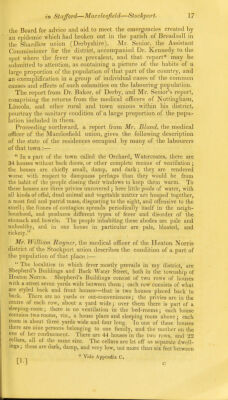
![the Board for advice and aid to meet the emergencies created by an epidemic which had broken out in the parish of Breadsall in the Shardlow union (Derbyshire). Mr. Senior, the Assistant Commissioner for the district, accompanied Dr. Kennedy to the spot where the fever was prevalent, and that report* may be submitted to attention, as containing a picture of the habits of a large proportion of the population of that part of the country, and an exemplification in a group of individual cases of the common causes and effects of such calamities on the labouring population. The report from Dr. Baker, of Derby, and Mr. Senior’s report, comprising the returns from the medical officers of Nottingham, Lincoln, and other rural and town unions within his district, pourtray the sanitary condition of a large proportion of the popu- lation included in them. Proceeding northward, a report from Mr. Bland, the medical officer of the Macclesfield union, gives the following description of the state of the residences occupied by many of the labourers of that town :— “ In a part of the town called the Orchard, Watercoates, there are 34 houses without back doors, or other complete means of ventilation ; the houses are chiefly small, damp, and dark; they are rendered worse with respect to dampness perhaps than they would be from the habit of the people closing their windows to keep them warm. To these houses are three privies uncovered; here little pools of water, with all kinds of offal, dead animal and vegetable matter are heaped together, a most foul and putrid mass, disgusting to the sight, and offensive to the smell; the fumes of contagion spreads periodically itself in the neigh- bourhood, and produces different types of fever and disorder of the stomach and bowels. The people inhabiting these abodes are pale and unhealthy, and in one house in particular are pale, bloated, and rickety.” Mr. William Rayner, the medical officer of the Heaton Norris district of the Stockport union describes the condition of a part of the population of that place :— “ The localities in which fever mostly prevails in my district, are Shepherd’s Buildings and Back Water Street, both in the township of Heaton Norris. Shepherd’s Buildings consist of two rows of houses with a street seven yards wide between them ] each row consists of what are styled back and front houses—that is two houses placed back to back. There are no yards or out-conveniences; the privies are in the centre of each row, about a yard wide; over them there is part of a sleeping-room; there is no ventilation in the bed-rooms; each house contains two rooms, viz., a house place and sleeping room above ; each room is about three yards wide and four long. In one of these houses there are nine persons belonging to one family, and the mother on the eve of her confinement. There are 44 houses in the two rows, and 22 cellars, all of the same size. The cellars are let off as separate dwell- ings ; these are dark, damp, and very low, not more than six feet between [1-1 * Vide Appendix C. C](https://iiif.wellcomecollection.org/image/b21365143_0053.jp2/full/800%2C/0/default.jpg)