The cyclopaedia of practical medicine: comprising treatises on the nature and treatment of diseases, materia medica and therapeutics, medical jurisprudence, etc., etc (Volume 2).
- Date:
- 1849-59
Licence: Public Domain Mark
Credit: The cyclopaedia of practical medicine: comprising treatises on the nature and treatment of diseases, materia medica and therapeutics, medical jurisprudence, etc., etc (Volume 2). Source: Wellcome Collection.
Provider: This material has been provided by the National Library of Medicine (U.S.), through the Medical Heritage Library. The original may be consulted at the National Library of Medicine (U.S.)
102/812
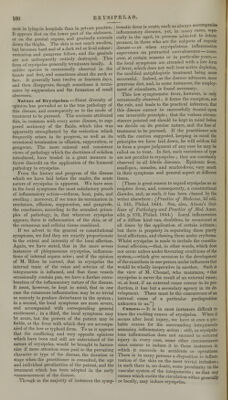
![mon in lying-in hospitals than in private practice. It appears first on the lower part of the abdomen, or on the genital organs, and gradually extends down the thighs. The skin is not much swollen, but becomes hard and of a dark red or livid colour: vesication and gangrene follow, and the genitals are not unfrequently entirely destroyed. This form of erysipelas generally terminates fatally. A milder species is occasionally observed in the hands and feet, and sometimes about the neck or face. It generally lasts twelve or fourteen days, and then disappears, though sometimes it termi- nates by suppuration and the formation of small abscesses. Nature of Erysipelas. — Great diversity of opinion has prevailed as to the true pathology of this disease, and consequently as to the mode of treatment to be pursued. The ancients attributed this, in common with every acute disease, to sup- posed acrimony of the fluids, which idea was apparently strengthened by the vesication which frequently arises in its progress, as well as its occasional termination in effusion, suppuration, or gangrene. The more rational and consistent views of pathology which the doctrines of solidism introduced, have tended in a great measure to throw discredit on the application of the humoral pathology to erysipelas. From the history and progress of the disease which we have laid before the reader, the acute nature of er3'sipelas is apparent. We have seen in the local symptoms the most satisfactory proofs of inflammatory action—redness, heat, pain, and swelling : moreover, if we trace its termination in resolution, effusion, suppuration, and gangrene, the conclusion, according to the soundest princi- ples of pathology, is, that wherever erysipelas appears, there is inflammation of the skin, or of the cutaneous and cellular tissue combined. If we advert to the general or constitutional s)'mptoms, we find they are exactly proportionate to the extent and intensity of the local affection. Again, we have stated, that in the more severe instances of phlegmonous erysipelas, inflamma- tions of internal organs arise; and if the opinion of M. Ribes be correct, that in erysipelas the internal tunic of the veins and arteries of the integuments is inflamed, and that these vessels occasionally contain pus, we have a further corro- boration of the inflammatory nature of the disease. It must, however, be kept in mind, that in one case the cutaneous inflammation may be so trivial as scarcely to produce disturbance in the system ; in a second, the local symptoms are more severe, and accompanied with corresponding general excitement; in a third, the local symptoms may be acute, but the powers of the patient may be feeble, or the fever with which they are accompa- nied of the low or typhoid form. To us it appears that the conflicting and very opposite opinions which have been and still arc entertained of the nature of erysipelas, would be brought to harmo- nize if more attention were paid to the prevailing character or type of the disease, the duration or stage when the practitioner is consulted, the age and individual peculiarities of the patient, and the treatment which has been adopted in the early commencement of the disease. Though in the majority of instances the symp- tomatic fever is acute, such as always accompanies inflammatory diseases, yet, in many cases, e.spe- cially in the aged, in persons addicted to uiteni- perance, in those who arc the subjects of organic jisease or when erysipelatous inflammation supervenes on protracted convalescence — more- over, at certain seasons or in particular years,— the local symptoms arc attended with a low form of fever, which does not well bear active depletion, the modified antiphlogistic treatment being more successful. Indeed, as the disease advances, more generous diet, and, in some instances, the employ- ment of stimulants, is found necessary. This low symptomatic fever, however, is only occasionally observed ; it forms the exception, not the rule, and leads to the practical inference, that this disease cannot be successfully treated upon one invariable principle ; that the various circum- stances pointed out should be kept in mind before we decide on its precise nature, and the line of treatment to be pursued. If the practitioner acts with the caution suggested, keeping in mind the principles we have laid down, he will seldom fail to form a proper judgment of any case he may be called on to treat. In fact, such variations of type are not peculiar to erysipelas ; they are constantly observed in all febrile diseases. Epidemic fever, small-pox, measles, and scarlet-fever, vary much in their symptoms and general aspect at different times. [There is great reason to regard erysipelas as an eruptive fever, and, consequently, a constitutional disorder, and, as such, it has been classed by the writer elsewhere : (^Practice of Medicine, 2d edit, ii. 545, Philad. 1844. See, also, Alison's Out- lines of Pathology and Practice of Med. Amer. edit. p. 276, Philad. 1844.) Local inflammation of a diffuse kind can, doubtless, be occasioned at ail times by the application of certain irritants; but there is propriety in separating these purely local affections, and classing them under erythema. Whilst erysipelas is made to include the constitu- tional affection,—that, in other vs'ords, which does not occur unless under favouring conditions of the system,—which give occasion to the development of the exanthem in one person under influences that would be wholly inoperative in another. Such is the view of M. Chome!, who maintains, that erysipelas is never the result of an external cause; or, at least, if an external cause concur in its pro- duction, it has but a secondary agency in its de- velopment. There must be the concurrence of an internal cause of a particular predisposition unknown to us.] Causes. — It is in most instances diflicult to trace the exciting causes of erysipelas. When it occurs after local injury, we have at once a pro- bable reason for the surrounding integuments assuming inflammatory action : still, as erysipela- tous inflammation does not succeed to external injury in every case, some other circumstances must concur to induce it in those instances in which it succeeds to accidents or operations. There is in many persons a disposition to inflam- mation of the skin on the most trivial irritation; in such there is, no doubt, some peculiarity in the vascular system of the integuments; so that any causes which excite the circulation either generally or locally, may induce erysipelas.](https://iiif.wellcomecollection.org/image/b21116817_0102.jp2/full/800%2C/0/default.jpg)