Course of qualitative chemical analysis / by the late Wm. Geo. Valentin.
- Valentin, W. G.
- Date:
- 1880
Licence: Public Domain Mark
Credit: Course of qualitative chemical analysis / by the late Wm. Geo. Valentin. Source: Wellcome Collection.
24/290 page 10
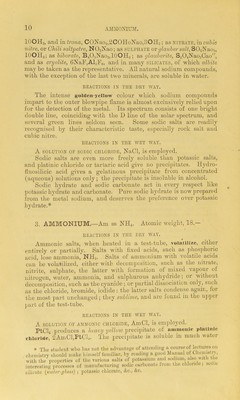
![IOOH2, andinimia, CONao,,2COHoNao,30Ho ; as NITRATE, in euhic nitre, or Chili saltpetre, N02Nao; as sulphate or glauber salt, SOoNaoa, IOOH2; as hihorate, BiO5Nao2,10OH2; as glauberite, S204Nao2Cao, and as cryolite, 6NaF,AI.Fe, and in many silicates, of -whicb albite may be taken as the reiiresentative. All natural sodium compounds, with the exception of the last two minerals, are soluble in water. reactions in the dry way. The intense goiacn-yellow colour which sodium compounds impart to the outer blow'pipe flame is almost exclusively relied upon for the detection of the metal. Its spectrum consists of one bright double line, coinciding with the D line of the solar spectrum, and several green lines seldom seen. Some sodic salts are readily recognised by their characteristic taste, especially rock salt and cubic nitre. reactions in the wet way. A solution of sodic chloride, NaCl, is employed. Sodic salts are even more freely soluble than potassic salts, and ])latinic chloride or tartaric acid give no precipitates. Hydro- Huosilicic acid gives a gelatinous precipitate from concentrated (aqueous) solutions only ; the precipitate is insoluble in alcohol. Sodic hydrate and sodic carbonate act in every respect like potassic hydrate and carbonate. Pure sodic hydrate is now prepared from the metal sodium, ixnd deserves the preference over potassic hydrate.* 3. AMMONIUM.—Am = NH4. Atomic weight, 18.- reacttons in the dry way. Ammonic salts, when heated in a test-tube, vtHsuiilzc, either (;ntirely or partially. Salts with fixed acids, such as phosphoric acid, lose ammonia, NII2. Salts of ammonium with volatile acids can be volatilized, either with decomposition, such as the nitrate, nitrite, sulphate, the latter with formation of mixed vapour of nitrogen, water, ammonia, and sulphurous anhydride ; or without decomposition, such as the cyanide ; or partial dissociation only, such as the chloride, bromide, iodide: the latter salts condense again, lor the most part unchanged; they sublime, and arc found in the uj)per jjurt of the test-tube. REACTIONS IN THE WET WAY. A SOLUTION OF AMHONic CHLORIDE, AmCl, is employed. PtCh produces a heavy yellow precipitate of aiiiimmic iiiatlnle chlorine, 2AmCl,PtCl4. The precipitate is soluble in much water * The student who lias not the advantage of attending a course of ledures on . ehen.istry should make himself familiar, by reading a good Manual ot Chenusin, with the properties of the various salts of potassium and sodium, also uitli t le interesting processes of manufacturing sodic carbonate from the chloride ; soc ic silicate (ivaler-gluss) ; potassic chlorate, &c., &c.](https://iiif.wellcomecollection.org/image/b28058793_0024.jp2/full/800%2C/0/default.jpg)


 No text description is available for this image
 No text description is available for this image
 No text description is available for this image