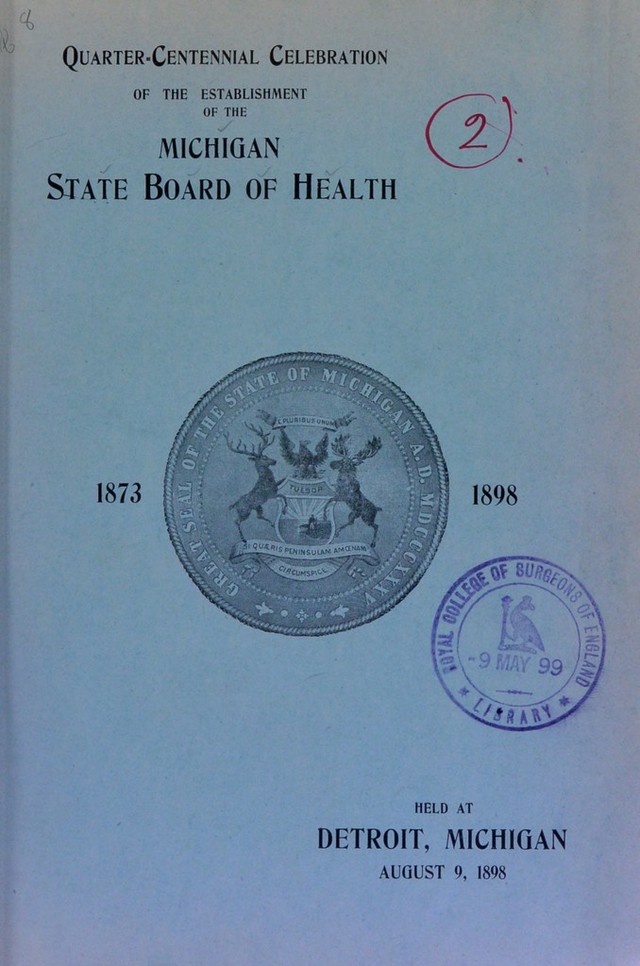
Proceedings of the quarter-centennial celebration of the establishment of the Michigan State Board of Health : held at Detroit, Michigan, August 9, 1898.
- Michigan. State Board of Health
- Date:
- 1898
Licence: Public Domain Mark
Credit: Proceedings of the quarter-centennial celebration of the establishment of the Michigan State Board of Health : held at Detroit, Michigan, August 9, 1898. Source: Wellcome Collection.
Provider: This material has been provided by The Royal College of Surgeons of England. The original may be consulted at The Royal College of Surgeons of England.
31/102 page 29
![small pox, as suggested bj' deniier, until it was brought about by Pas- teur’s researches into the causes of certain forms of disease in French vineyards. There were earlier discoveries of bacteria by Leeuwenhoeck and others, in almost every kind of organic matter in process of decom- position, but the part they played in disease was not even hinted at. In 1840 Ilenle announced that the cause of miasmatic infective con- tagious <liseases must be looked for in similar minute living organisms. He was unable to offer any satisfactory experimental proof of his theory. But his argument in favor of it created a profound impression, and from that time forward greatly increased attention was given by medical and other microscopists to all infective diseases. In 1843 Mitscherlich pointed out that as yeasts gave rise to fermentation, so vibrios in like manner must be the cause of putrefaction; and Belmholtz showed that by the use of a 'membrane it was possible to separate from a putrefying liquid a fluid which, under suitable conditions, would remain sterile without the application of heat or chemicals. In 1849 Pollender discovered microbes in the blood of the spleens of cows that had died of splenic fever; this discovery recalled attention to what Ilenle had suggested, that these organisms were in some way etiologically connected with the outbreak of anthrax. Six j'ears later he gave a more detailed description of his discovery, but meanwhile Davaine and Bayer described bacteria taken from the blood of animals affected with splenic fever. In 1857 Pasteur described a new fermenting organism which he showed had the power of forming lactic acid from sugar. For this, however, the presence of nitrogenous matter was essential, not because the ele- ments were required for the composition of the lactic acid, but because they were necessary for the nutrition of the organism which produces it, thus throwing a new light upon the relation between cause and effect in fermentation. In 1862 Pasteur i)ublished his paper on organized corpuscles existing in the atmosphere, and by a series of experiments showed that unless organisms were introduced into the organic fluids from without, by some means or other, no i>utrefaction could take place —that is, until some organisms were present which could grow and multiply in the fluid, no evidence of organic life would make its appear- ance. In this year, too, Tranbe showed that ammoniacal fermentation of the urine in the bladder would not take place if the access of vibrios from without were prevented; and Pasteur, after insisting ujion the same fact, indicated that this fermentation might be prevented by the presence of boracic acid, and he proposed that in cases of operations on the bladder the parts should be kept irrigated as far as possible with a three or four per cent solution of that substance. This lucid paper of Pasteur on “‘Organized Corpuscles in the Air” was the prelude to Professor Lister’s exj)eriments on the antiseptic treat- ment of wounds, first undertaken three years after Pasteur’s paper. His exjteriments at the first were crude and difficult of apj)lication, but with a persistence commensurate with his nobleness of pur])Ose, after two ,%ears j)erseverance he had rendered them so facile and so successful in his hands that, in 1867, he insisted upon the importance of excluding specijil bacterial organisms from wounds. It is no disparagement of the brilliancy of the results of following I rofessor Lister’s practice in the application of knowledge of disease](https://iiif.wellcomecollection.org/image/b22335213_0033.jp2/full/800%2C/0/default.jpg)