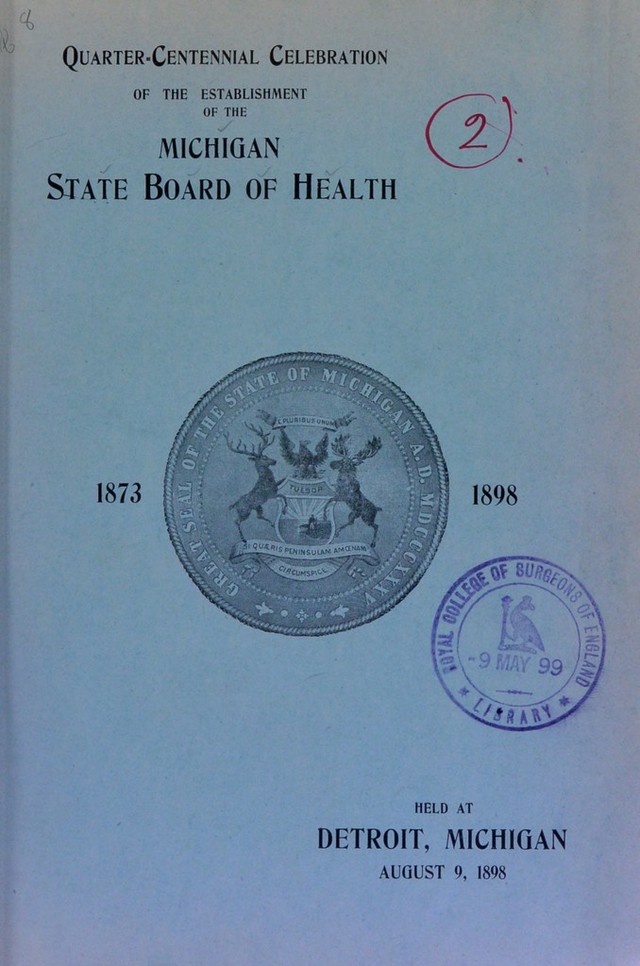
Proceedings of the quarter-centennial celebration of the establishment of the Michigan State Board of Health : held at Detroit, Michigan, August 9, 1898.
- Michigan. State Board of Health
- Date:
- 1898
Licence: Public Domain Mark
Credit: Proceedings of the quarter-centennial celebration of the establishment of the Michigan State Board of Health : held at Detroit, Michigan, August 9, 1898. Source: Wellcome Collection.
Provider: This material has been provided by The Royal College of Surgeons of England. The original may be consulted at The Royal College of Surgeons of England.
45/102 page 43
![l)t)cket.’’ The sanitarian might well take up the wail of the old Hebrew jirophet, “My people are destroyed for lack of knowledge.” Potable Water, In former years the ideal of wat(;r for domestic and potable use was “Sparkling and bright in its liquid light Is the water in our glasses.” If this was secured nothing more was required. In popular estimation clear water was clean water. It seemed impossible that bright, sparkling water could become a vehicle of disease. Early in my medical practice 1 had the care of a family that had a singular a})titiule to get sick, and recovery was slow and uncertain. So far as the famih’ was concerned the cause was not obvious. Temperate, moral, regular in their habits, they had no‘good excuse to be sick. After weighing several possible causes of this valetudinarianism, my suspicions linally fastened upon the family well, and I suggested to the father my suspicions. He took up a glass of the water, tasted, smelled and critically examined with his eye and said, “Clear as crystal, and transparent as airl Here is no cause for sickness.” The family went lingeringly down TO death. The place was sold and came into possession of a family noted for vigorous health, when the old scenes of mysterious sickness csime again on the stage. The well was condemned absolutely, closed up and a new one dug. \Vith the new well the family got well and remained well. Once the inquiry was how to cleanse water already soiled and make it tit for potable use; we ask(*d for some Elisha to cast a cruse of salt into the spring to heal the water of bitterness and death. How slow we were To learn that germs of disease may clothe themselves with garments of light. The new demand for domestic and potable water is innocence not repentance—not healing, but health. Drainage of Swamps. It is a ])leasing thought that many operations begun for a specific pur- ])ose introduce, incideatally, benefits outweighing the good directly sought. A good illustration is furnished in the legislation to secure the (b'aiiiage of swami)s, “to reclaim waste lands for agricnltui’al y)urposes.” The government surveys of the lower peninsula reported one-ninth of the area as swanq). An exaggeration undoubtedly. If the surveyors told the truth, they told more than the truth. Rut thei’e was enougli swam]) land to give a bad name to our State, and impress a decided malarial character nj)on our autumnal fevers. Ihe summer and autumn of 18.5fi was verv dry, and the fall fires that usually burn only the fallen leaves of the forests, burned out the muck swamps, burning off the roots of the marshy shrubs and trees and filling tlieJ)urned-out basins of the swamps with fallen timbei'. The season of 1K.)7 was A’ery rainy and the bai’k and .branches of the fallen timber rot- ting in file pools of stagnant water caused a fearful amount of malai-ial disease in the State; in many neighborhoods there were not enough well ])eisons to gi^-e a cup of cold water to tlie sick. The mortality was not great but the suffering was very general.](https://iiif.wellcomecollection.org/image/b22335213_0047.jp2/full/800%2C/0/default.jpg)