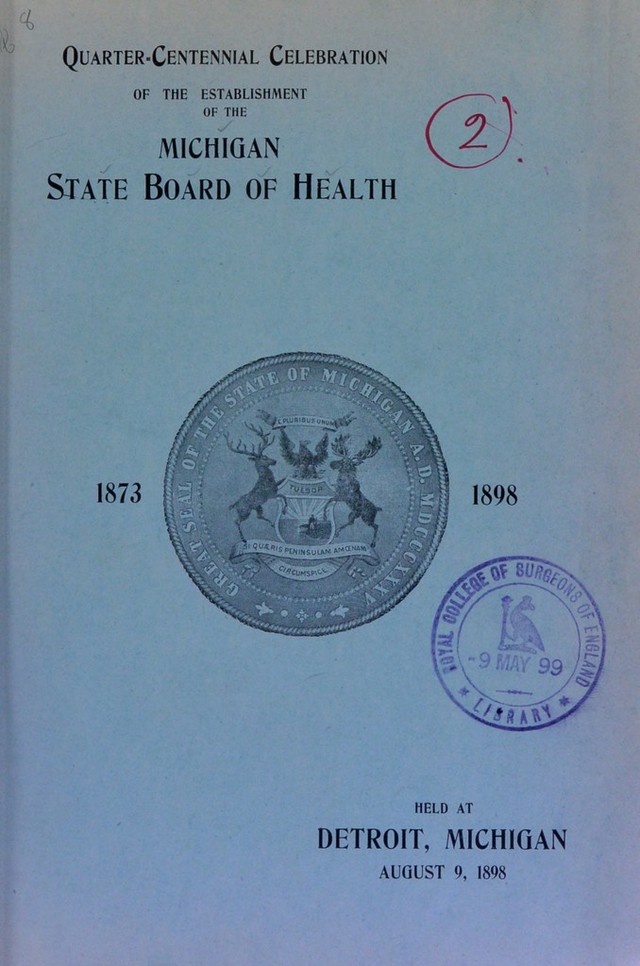
Proceedings of the quarter-centennial celebration of the establishment of the Michigan State Board of Health : held at Detroit, Michigan, August 9, 1898.
- Michigan. State Board of Health
- Date:
- 1898
Licence: Public Domain Mark
Credit: Proceedings of the quarter-centennial celebration of the establishment of the Michigan State Board of Health : held at Detroit, Michigan, August 9, 1898. Source: Wellcome Collection.
Provider: This material has been provided by The Royal College of Surgeons of England. The original may be consulted at The Royal College of Surgeons of England.
49/102 page 47
![chief functions will be to teach the i)eoi>le the laws which concern the maintain an up-to-date acquaintance with the science of sanitation; for that is the foundation upon which its public utility will largely depend. In that capacity, as a fountain and source of information, one of the health of communities, and especially, how to apply them. Sanitary laws are discovered and recognized by the careful and intel- ligent observation of facts. (A single fact by itself is of little value.) But the accurate observation of a large number of facts, admitting of classilication and comparison, and corroborated when ])ossible by ex- ])erinient, are the means by which a knowledge of the laws of nature is acquired, ^^'hen such laws are tested and verified and found to be un- changeable, we call such knowledge, Science. The knowledge of natural law is science. Sanitary Science is a knowl- edge of the laws whicli govern in any way the physical development, the functional activity, the mental growth, and even the moral character, of the citizen, from his ante-natal existence even to the celebration of his funereal rites. The laws of sanitation with which a State Board of Health is mostly concerned are those which point to the dangers, the whirlpools and the ]ierils, that beset the sliij) of life throughout its course, and so chart out the voyage that it may escape the tempests of disease and avoid the rocks of hostile casualties and thus be piloted in safety to the haven of a good old age. Some of the best-known sanitary laws were very slow of recognition. For instance, nothing is better establisluHl than that certain diseases are contagions, and yet that law was not self evident, nor generally ac- co])ted until after generations of exjterlence and inaccurate observation. It is within the memory of the speaker that men standing high in re])u- tation, for intelligence and learning, both in and out of the medical pro- fession, denied tin* law of contagion, and vigorously disputed the facts u]K)u which it is based. And, on the other hand, the recognition of a sanitary law does not always depend upon the man of science, but is sometimes discovered and utilized by the common i)eo])le. In a large old book in my library, written more than l.oO years ago, by Kichard >Iead, ^I. 1)., the most noted medical man of his day. Court Phy- sician to George II., I find the following account of the discovery of a most imi)ortant contribution to sanitary science:—viz;—that innoculat- ing small-i)ox modifies the severity and duration of the disease. Dr. Mead writes:—“As far as I have been able to find out by empiiry, innoculation was the invention of the Circassians, the women of which country are said to excel in beauty; upon which account, it is veiw com- mon, es])ecially among the ])oorer sort, to sell young girls for slaves to be carried away into the neighboring ])arts. hen therefore it was observed, that they, who were seized with this distempcu', were in less danger both of their beauty and their life, the younger they were, they contrived this way of infecting the body, that the luerchandise might bring the greater profit.” From this discoA'eiw the prac- tice of innoculation for small-pox became common throughout civilized Furo])c, and about 100 years ago was introduced in this country and very generally ado])ted, until superseded by the safer method discovei'ed by the ijumortal Jenner, A'iz;—Vaccination. And even that, was the ])rior discovery of the English milk-maids, who told the Doctor, that they were](https://iiif.wellcomecollection.org/image/b22335213_0051.jp2/full/800%2C/0/default.jpg)