Comparison of the mortality from disease in armies : with that of men of military ages in civil life showing the groups of diseases chiefly concerned in causing the excess of mortality in armies / by A. Newman.
- Newman, A.
- Date:
- 1869
Licence: Public Domain Mark
Credit: Comparison of the mortality from disease in armies : with that of men of military ages in civil life showing the groups of diseases chiefly concerned in causing the excess of mortality in armies / by A. Newman. Source: Wellcome Collection.
Provider: This material has been provided by the Francis A. Countway Library of Medicine, through the Medical Heritage Library. The original may be consulted at the Francis A. Countway Library of Medicine, Harvard Medical School.
26/54 page 18
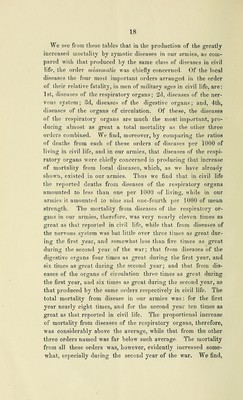
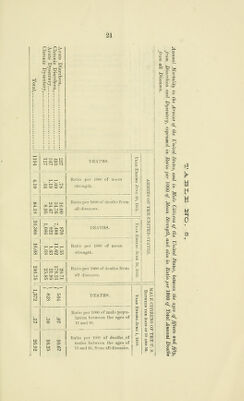
![We see from these tables that in the production of the greatly- increased mortality by zymotic diseases in our armies, as com- pared with that produced by the same class of diseases in civil life, the order miasm-atie was chiefly concerned. Of the local diseases the four most important orders arranged in the order of their relative fatality, in men of military ages in civil life, are: 1st, diseases of the respiratory organs: 2d, diseases of the ner- vous system; 3d, diseases of the digestive organs; and, 4th, diseases of the organs of circulation. Of these, the diseases of the respiratory organs are much the most important, pro- ducing almost as great a total mortality as the other three orders combined. We find, moreover, by comparing the ratios of deaths from each of these orders of diseases per 1000 of living in civil life, and in our armies, that diseases of the respi- ratory organs were chiefly concerned in producing that increase of mortality from local diseases, which, as we have already shown, existed in our armies. Tlius we find that in civil life the reported deaths from diseases of the respiratory organs amounted to less than one per 1000 of living, while in our armies it amounted to nine and one-fourth per 1000 of mean strength. The mortality from diseases of the respiratory or- gans in our armies, therefore, was very nearly eleven times as great as that reported in civil life, while that from diseases of the nervous system was but little over three times as great dur- ing the first year, and somewhat less than five times as great during the second year of the war; that from diseases of the digestive organs four times as great during the first year, and six times as great during the second year; and that from dis- eases of the organs of circulation three times as great during the first year, and six times as great during the second year, as that produced by the same orders respectively in civil life. The total mortality from disease in our armies was: for the first year nearly eight times, and for the second year ten times as great as that reported in civil life. The proportions] increase of mortality from diseases of the respiratory organs, therefore, was considerably above the average, while that from the other three orders named was far below such average. The mortality from all these orders was, however, evidently increased some- what, especially during the second year of the war. We find.](https://iiif.wellcomecollection.org/image/b21070477_0026.jp2/full/800%2C/0/default.jpg)

 No text description is available for this image
 No text description is available for this image
 No text description is available for this image