Comparison of the mortality from disease in armies : with that of men of military ages in civil life showing the groups of diseases chiefly concerned in causing the excess of mortality in armies / by A. Newman.
- Newman, A.
- Date:
- 1869
Licence: Public Domain Mark
Credit: Comparison of the mortality from disease in armies : with that of men of military ages in civil life showing the groups of diseases chiefly concerned in causing the excess of mortality in armies / by A. Newman. Source: Wellcome Collection.
Provider: This material has been provided by the Francis A. Countway Library of Medicine, through the Medical Heritage Library. The original may be consulted at the Francis A. Countway Library of Medicine, Harvard Medical School.
44/54 (page 36)
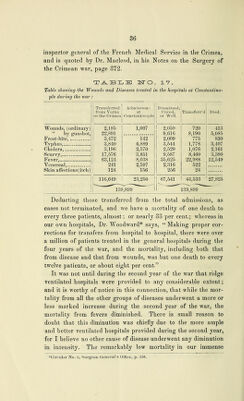
![inspector general of the French Medical Service in the Crimea, and is quoted by Dr. Macleod, in his Notes on the Surgery of the Crimean war, page 372. T-^BLIB isro. 17. Table showing the Wounds and Diseases treated in the hospitals at Constantino- ple during the war : Wounds, (ordinary) by gunshot, Frost-bite, Typhus, Cholera, Scurvy, Fever, Venereal, Skin affections(itch) Transferred from Varna, or the Crimea 2,185 22,891 3,472 3,840 3,196 17,576 63,124 241 124 AdmissionM at Constantinople 1,007 142 4,889 2,570 3,851 8,038 2,597 156 116,649 23,250 Dismissed, Cured, or Well. 139,899 2,059 9,616 2,009 3,544 2,529 9,587 35,625 2,316 256 67,541 Transferr'd ])ied. 720 8,190 775 1,778 1,076 8,460 22,988 522 24 413 5,085 830 3,407 2,161 3,380 12,549 44,533 27,825 139,899 Deducting those transferred from the total admissions, as cases not terminated, and we have a mortality of one death to every three patients, almost; or nearly 33 per cent.; whereas in our own hospitals. Dr. Woodward* says, Making proper cor- rections for transfers from hospital to hospital, there were over a million of patients treated in the general hospitals during the four years of the war, and the mortality, including both that from disease and that from wounds, was but one death to every twelve patients, or about eight per cent It was not until during the second year of the war that ridge ventilated hospitals were provided to any considerable extent; and it is worthy of notice in this connection, that while the mor- tality from all the other groups of diseases underwent a more or less marked increase during the second year of the war, the mortality from fevers diminished. There is small reason to doubt that this diminution was chiefly due to the more ample and better ventilated hospitals provided during the second year, for I believe no other cause of disease underwent any diminution in intensity. The remarkably low mortality in our immense](https://iiif.wellcomecollection.org/image/b21070477_0044.jp2/full/800%2C/0/default.jpg)